Macro Note · SEO
The Greenland Bet01
1/28/2026, 2:41:57 AM
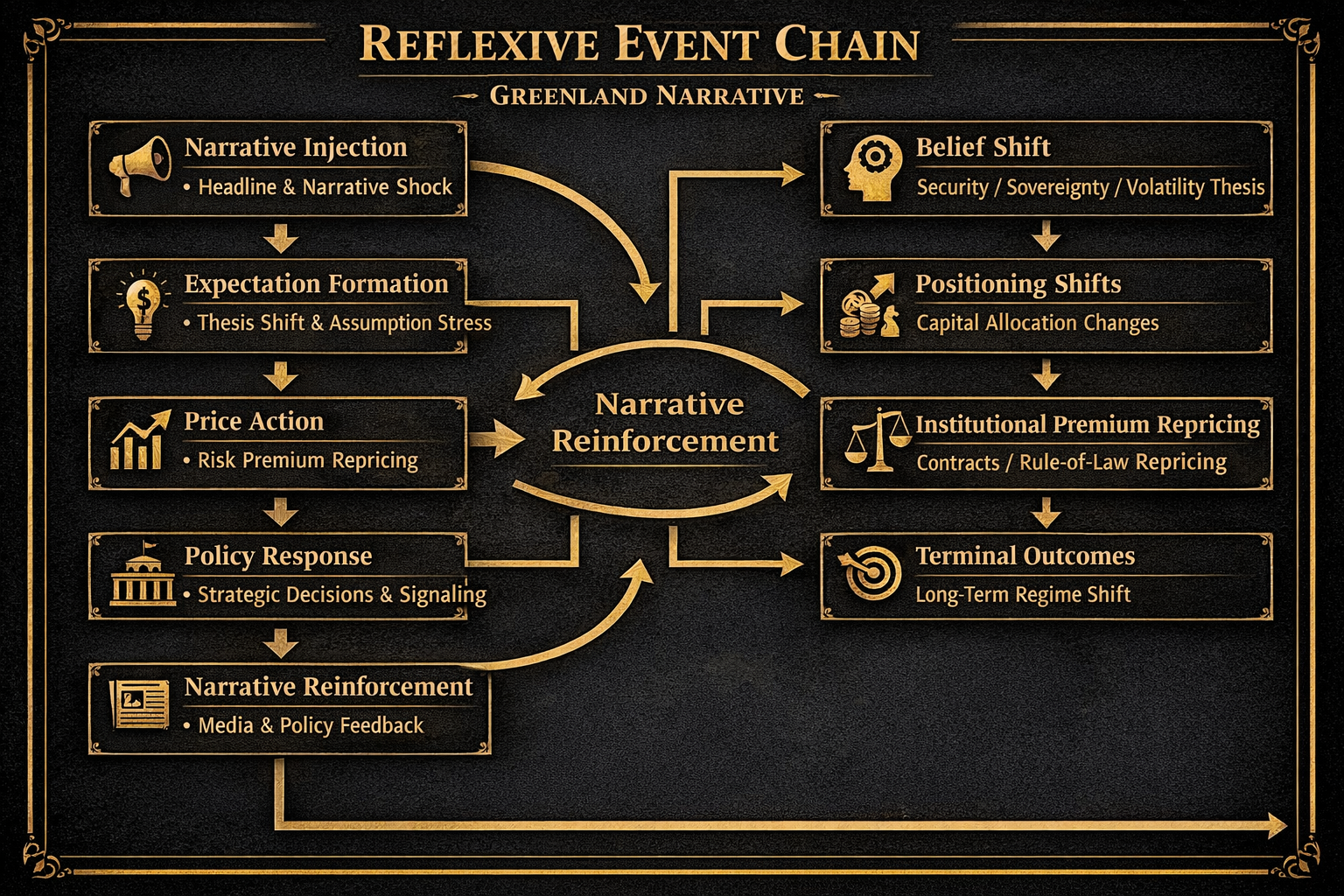
Reflexive Event Chain (Greenland Narrative) · TXT TREE └─ 0) Trigger Layer: Narrative Injection (政治叙事注入) ├─ 0.1 Headline: "US seeks control/influence over Greenland" ├─ 0.2 Market reads: "Arctic → security → supply chain → sovereignty stress" └─ 0.3 Reflexive seed: institutions become tradable variables (制度从常数变变量)
└─ 1) Belief Layer: Expectation Formation (预期形成) ├─ 1.1 Security-premium thesis strengthens │ └─ "critical minerals are strategic stockpile, not commodity" ├─ 1.2 Arctic-route thesis strengthens │ └─ "trade path optionality increases, chokepoints lose monopoly" └─ 1.3 NATO/international-law stability questioned └─ "alliance cohesion not guaranteed under hard security stress"
└─ 2) Positioning Layer: Capital Reallocation (仓位再配置) ├─ 2.1 Long: strategic resource complex (rare earths / critical minerals / energy upstream) ├─ 2.2 Long: defense / surveillance / arctic-capable infrastructure optionality ├─ 2.3 Hedge: vol (macro vol / commodities options / risk-off convexity) └─ 2.4 Short/Underweight: globalized long-supply-chain / low-margin trade-dependent sectors
└─ 3) Price Layer: Market Moves (价格行为) ├─ 3.1 Risk premia reprices │ ├─ security premium ↑ │ ├─ sovereignty premium ↑ │ └─ shipping-path optionality premium ↑ ├─ 3.2 Cross-asset correlations shift │ ├─ "risk-on" correlation regime weakens │ └─ geopolitical beta becomes priced factor └─ 3.3 Vol term structure reacts ├─ implied vol ↑ around event windows └─ skew demand ↑ (tail hedges bid)
└─ 4) Policy Layer: Strategic Response (政策响应) ├─ 4.1 Denmark/Greenland: sovereignty reaffirmation + autonomy narrative ├─ 4.2 US: "security cooperation" framing (bases/investment/de-risk supply chain) ├─ 4.3 NATO/EU: cohesion signaling vs domestic constraints └─ 4.4 Russia/China: exploit wedge (information ops / Arctic activity / investment narratives)
└─ 5) Feedback Layer A: Price → Narrative (价格反哺叙事) ├─ 5.1 Rising resource/defense prices validate original thesis │ └─ "market agrees this is strategic" ├─ 5.2 Risk-off episodes amplify media intensity │ └─ "headline density increases when vol spikes" └─ 5.3 Politicians use price moves as justification └─ "we must act because markets/risks"
└─ 6) Feedback Layer B: Narrative → Policy (叙事反哺政策) ├─ 6.1 More headlines → stronger domestic mandate for "security action" ├─ 6.2 Security framing crowds out legal/institutional objections └─ 6.3 Policy steps become new triggers (new bases, new mining deals, new sanctions)
└─ 7) Regime Shift Layer: Institutional Premium Repricing (制度溢价重定价) ├─ 7.1 Rule-of-law stability premium becomes discounted (制度溢价折价) ├─ 7.2 Alliances treated as conditional contracts (盟约从信仰变合同) └─ 7.3 Capital demands higher return for "political path risk"
└─ 8) Terminal Outcomes (可观测终局形态, not predictions) ├─ 8.1 Soft capture: US influence via bases + investment + supply contracts ├─ 8.2 Dual governance tension: autonomy push vs security dependence ├─ 8.3 Arctic militarization baseline rises (new normal) └─ 8.4 Pricing baseline: higher structural vol + higher commodity security premium
└─ 9) Trading Mapping (交易映射: structure, not calls) ├─ 9.1 Core trade: Security-premium spread │ ├─ Long: strategic resources / energy upstream / defense optionality │ └─ Short: globalized low-margin trade-dependent equities (or hedge via index/sector) ├─ 9.2 Vol trade: Event-window convexity │ ├─ Buy: commodity options / macro hedges around low-liquidity windows │ └─ Sell: only after thesis invalidation + premium collapse signals └─ 9.3 Regime monitor: Institutional premium gauges ├─ headlines density + policy steps frequency ├─ correlation regime breaks └─ sustained bid in tails (skew) as confirmation