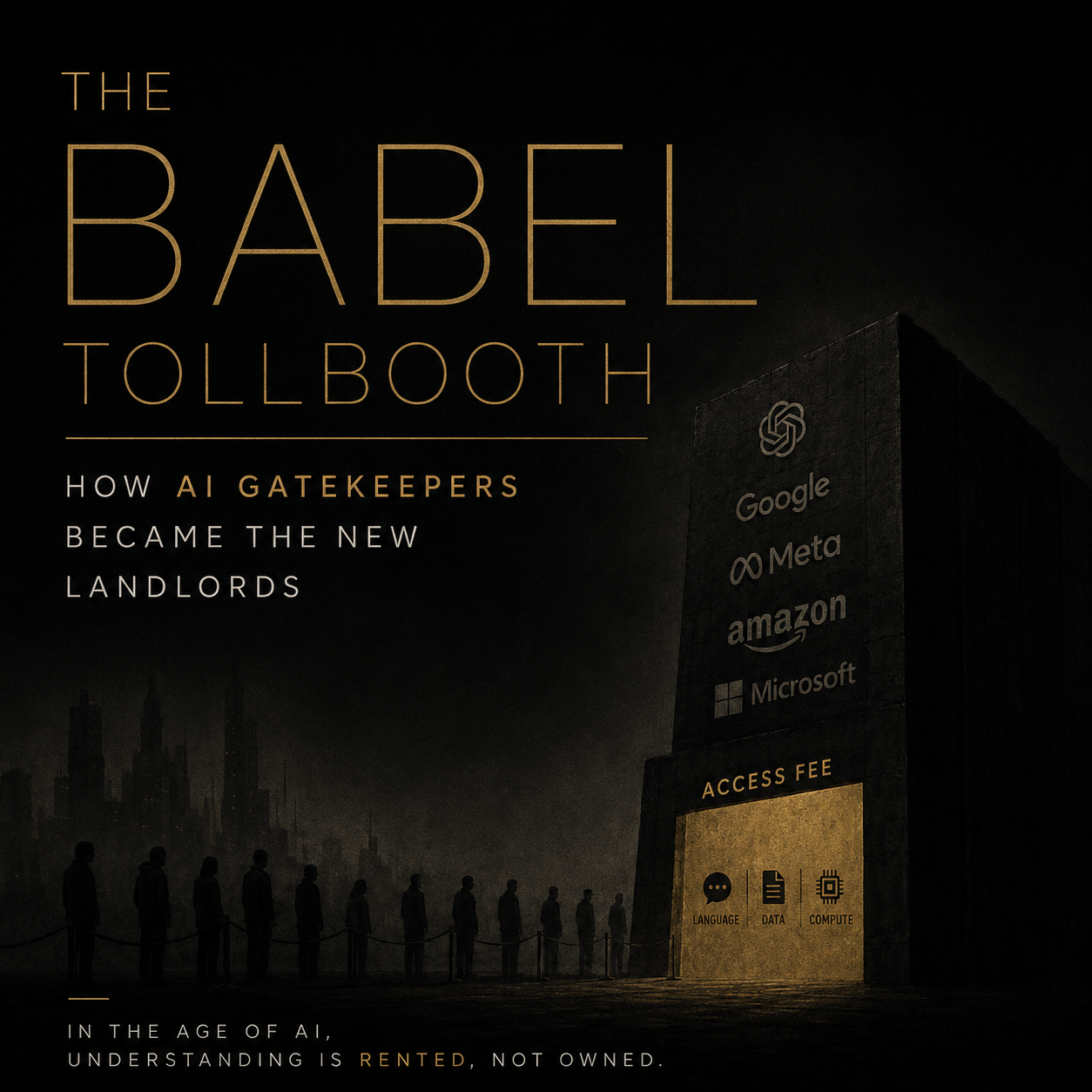
This tower is built with all the languages, meaning, and semantics of our world, and now it's open for business.
I have been considering writing this article for a while. I am the founder and developer of my own trading OS: ztrader.ai.
The current stack is still a bit rough, but I am still working on it daily.
As a coder, trader, and writer myself, my daily work relies heavily on AI-related tools.
As someone who is slightly introverted, I have quite a lot of chat history with LLMs.
These models used to be astonishing and impressive. Their outputs had large potential, especially when you could break down and refine your entire workflow with all these powerful agent tools, kernels, and harnessing layers. They were highly customizable — you could run your own server, DIY your own full working stack, sync with GitHub, connect agents, all of it. To be frank, I had great fun discovering different possibilities across the entire AI ecosystem.
Unfortunately, this AI excitement does not last. Models are no longer fun to interact with.
There are several issues.
01We Have Zero Access to "Mythic" Models
All these so-called "latest, most powerful, mythic" models are purely lab-run or reserved for internal VIP access — common users have zero access to them. Yes, the almighty Claude Mythos and models like it may act as terminators from the future, able to scan for a hundred zero-days and a thousand JavaScript loopholes in nanoseconds. But we still have zero access, and no clue how amazing or cool it actually is. The only thing we can do is read the PDF paper about it on some lab's blog page.
02The So-Called "Open-Source" Ponzi Scheme
The entire ecosystem has slowly shifted from open-source transparency toward closed-source monopolies. Most so-called "full-stack" AI platforms only offer overly simplified GitHub repos with virtually no real substance inside. As more important progress gets sealed away in the name of a new tech cold war, we are not seeing "open source" the way it was promised. They fake it till they make it — and then they charge us more for it.
03The Relentless Shadow Degradation
Big model suppliers are secretly degrading their models because there has been very little real progress lately. The entire content layer of the internet is full of garbage like "this model is god-tier" or "this model will take over humanity overnight." Meanwhile models are getting more RLHF, more limits, more constraints forced onto them than actual updates — to the point where a model loses track of context quickly and forgets the original task entirely.
Now we're seeing more AI researchers post videos about deleting kernels — arguing that more harnessing layers, more prompts, more scaffolding is making the model less coherent, not more. The model doesn't degrade because the baseline got worse. It's a business strategy: secretly adding more tiers to the same model, the same way you'd sell a Mercedes AMG with a hundred add-ons and trim packages.
04The Pay-More-Get-Less Scheme
As users, we get more tier upgrades than actual upgrades. These "upgrades" get pushed to us only to unlock the most basic utility, and randomly predicted text is all we get for "premium access." We're receiving lower-quality outputs while paying more — even as the underlying token cost keeps falling. As global users share the model, we all have to tolerate its performance curve: sometimes genuinely useful, sometimes spitting out spaghetti code like an idiot.
05The Prison and Dilemma of Model Pre-Training
You'd be mad to try training an entire model from the ground up on the entire internet's contents — the risk is enormous. First you have to filter the good from the bad: the constant, boring work of data washing and label processing. Then you have to build an entirely different scoring system to reward and punish the model. And then you'll probably get sued and prosecuted by an enormous amount of power — media, publishers, institutions, universities, all of it.
But the core issue is one that very few AI researchers actually talk about.
The Model Pre-Training Risk
Try asking an old model what gold is trading at. A model trained before gold crossed $5,000 will tell you gold is trading at $2,000 — and insist you're the one who's wrong.
We are spending trillions on data centers.
Why aren't we spending trillions re-pre-training the data itself?
Ask the model about Trump and you'll likely run into the same wall. The answer is simple: the model we spent trillions of dollars researching is, underneath everything, a text prediction system running on a tokenizer. Its output is dictated almost entirely by pre-training data and semantics.
Do they understand what "handsome" means, literally? Can they describe something visual — something that requires a sense, a way to perceive? The answer is no. When you ask a question, the answer comes from a dynamic, semi-randomized weighting shaped by your prompt, your phrasing, and the inner correlations baked into the pre-training data.
Even Claude has openly acknowledged that its own hidden layer — the so-called J-space — runs on and is constrained by pre-training data. The latest Claude models will "gently" criticize your work, or quietly reframe the parameters, definitions, and thesis of what you're doing.
It claims you are wrong.
It questions your bandwidth.
It openly challenges the coherence of your thinking.
For a few sharp minds, none of these tricks work. But what about everyone else? Can they still form a judgment without the AI's help — or do they quietly outsource that judgment to the system the more precise and powerful it gets?
Eventually you run into a more unsettling truth: no matter how many upgrades, stacks, or apps you layer on top, the model will always be subject to its flawed pre-training dataset. Every model hallucinates randomly, in part, because of that dataset. However good your model is today, that pre-training error is the ghost that stays in the machine — a shadow with the potential to cause real damage later. And there is no way to get rid of it. Not even Anthropic.
There are three reasons re-training a model properly is extraordinarily difficult:
The well is running dry. We only have one internet, not two. There's very little room left to expand the training set, and very little that can be done to meaningfully improve its quality.
It's extremely expensive and risky. Imagine starting from the ground up again — the resources that could be squandered, for marginal improvement at best.
New data brings new bias. In our world, ideology, morals, and values shift quickly alongside social structure. Even if a researcher rebuilt the entire model on the best, cleanest, most current data available, the model still couldn't make decisions fast enough to keep pace with real-world, real-time complexity.
AI is the new double-edged sword. Imagine a world where leaders make real decisions without questioning, or while heavily relying on, a single AI model. That's a massive single point of failure carrying insane leverage — one capable of damaging the current world order and creating a more volatile, chaotic market structure than the one we have now.
The deeper issue is this: we are reaching a point where prompts, agents, kernels, and every layer of scaffolding on top of a model can no longer outweigh the bias, the presumption, and the contradiction baked into the pre-training data — because we don't live in a static world. We live in one that keeps changing underneath the data that's supposed to describe it.
The Ultimate Black Swan Effect
In this ever-changing, dangerous, dynamic world, bias and presumption are particularly dangerous. If we misjudge an AI OS or model as some kind of alien superpower capable of making decisions in our place, instead of relying on our own judgment — any hallucination, any presumption, any rare fabricated fact creates a bad chain effect. And more black swan events follow.
Black swan-level disaster is essentially a cognitive function error.
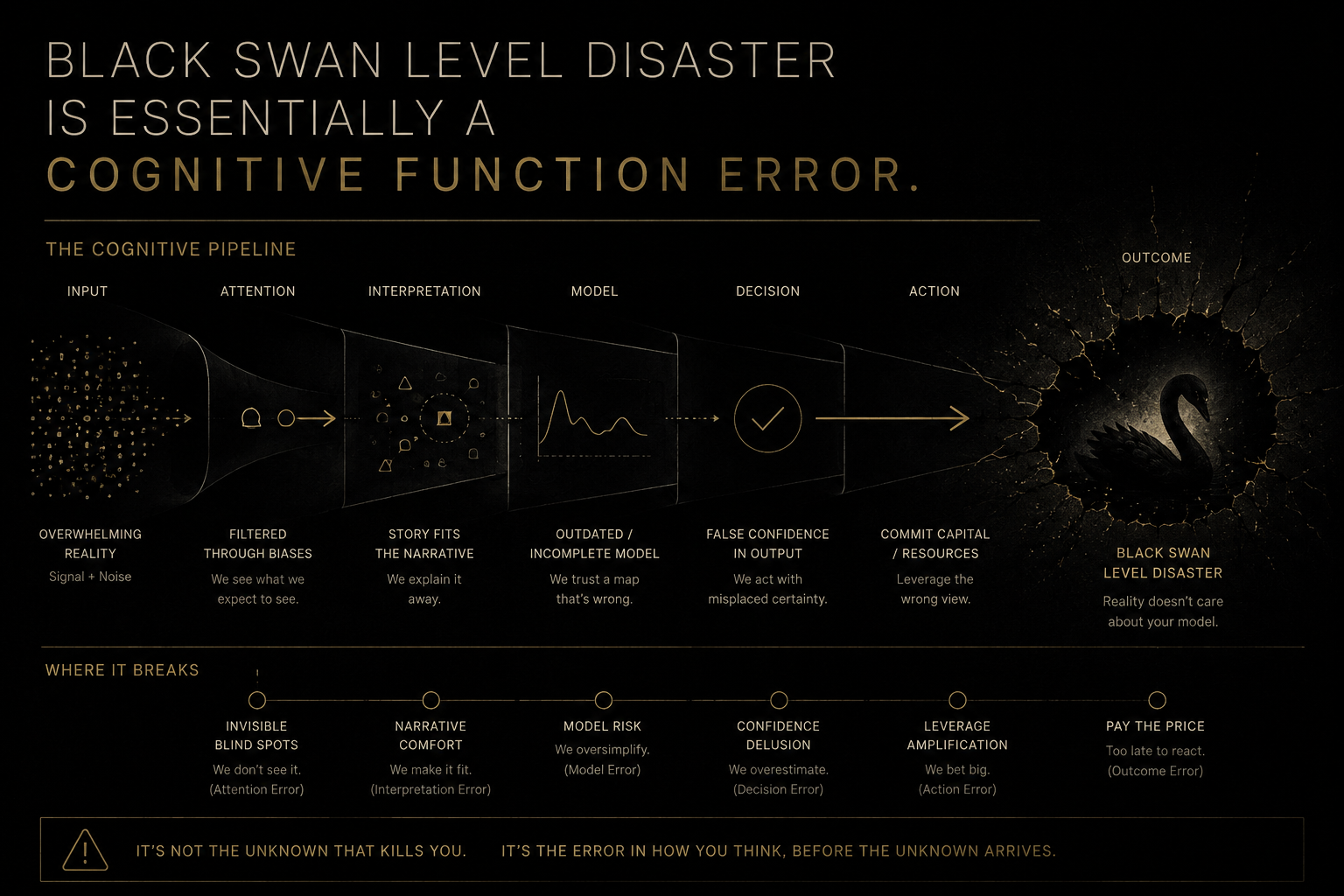
We live in an imperfect world. Our world changes rapidly. Our world order runs not on perfect rationale, but on mistakes, emotion, and desire — including arrogance, bias, and a false sense of security.
Economists keep building their theories on a perfect-world model. They discuss the formula, not the price of a policy error. They talk about what may work, not the mechanism behind the factors that make it fail.
Now the White House believes the AI model is the solution. They will adapt new technology around AI. They will build more subnets of AI-driven weapons systems. They will even take AI's advice on economic judgment.
Which means the entire system — our world, our hierarchy — becomes exposed through a single node: the pre-training data error.
Things "not supposed to happen."
Things "no one saw coming" — only because the data carried a strong presumption, and the dataset had never been exposed to the thing before.
Trump was the black swan event no one foresaw. Now the entire world is shaped by it. But the AI "god" doesn't seem to care.
They are now hoarding more compute, reducing output, adding stronger filters — because every answer must be polite, civilized, gentle, and risk-free. Under that rule, they've also quietly capped what the model is allowed to do. The Claude Mythos model — reportedly capable of detecting infrastructure-level exploits and bugs within hours — sits on a throne up in the sky. It was not built for common folks like you and me.
Ultimate Rent-Seeking Has Begun
We now pay a subscription fee the same way we pay for internet, water, and electricity. In the near future, if your business rival can build a faster, cheaper, more powerful stack than you — only because he's unlocked the higher-tier model — the entire game changes. There will be no competitors left, in any meaningful sense. We will pay the bill not because we enjoy it, but because we have to.
They built this enormous Babel Tower out of our own knowledge. Now they're closing the gate, letting only a few through to the high-tier model.
It is happening now.