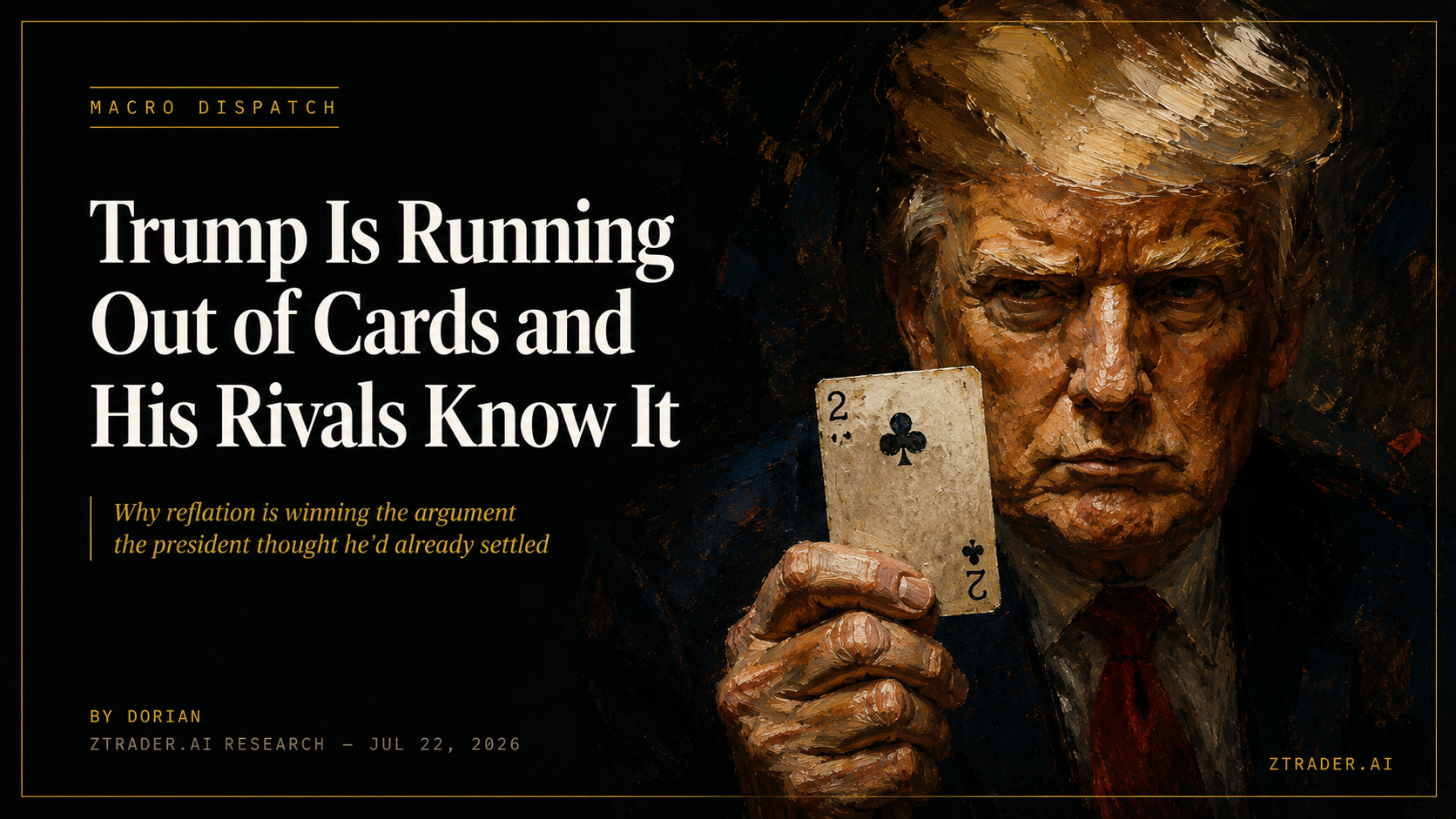
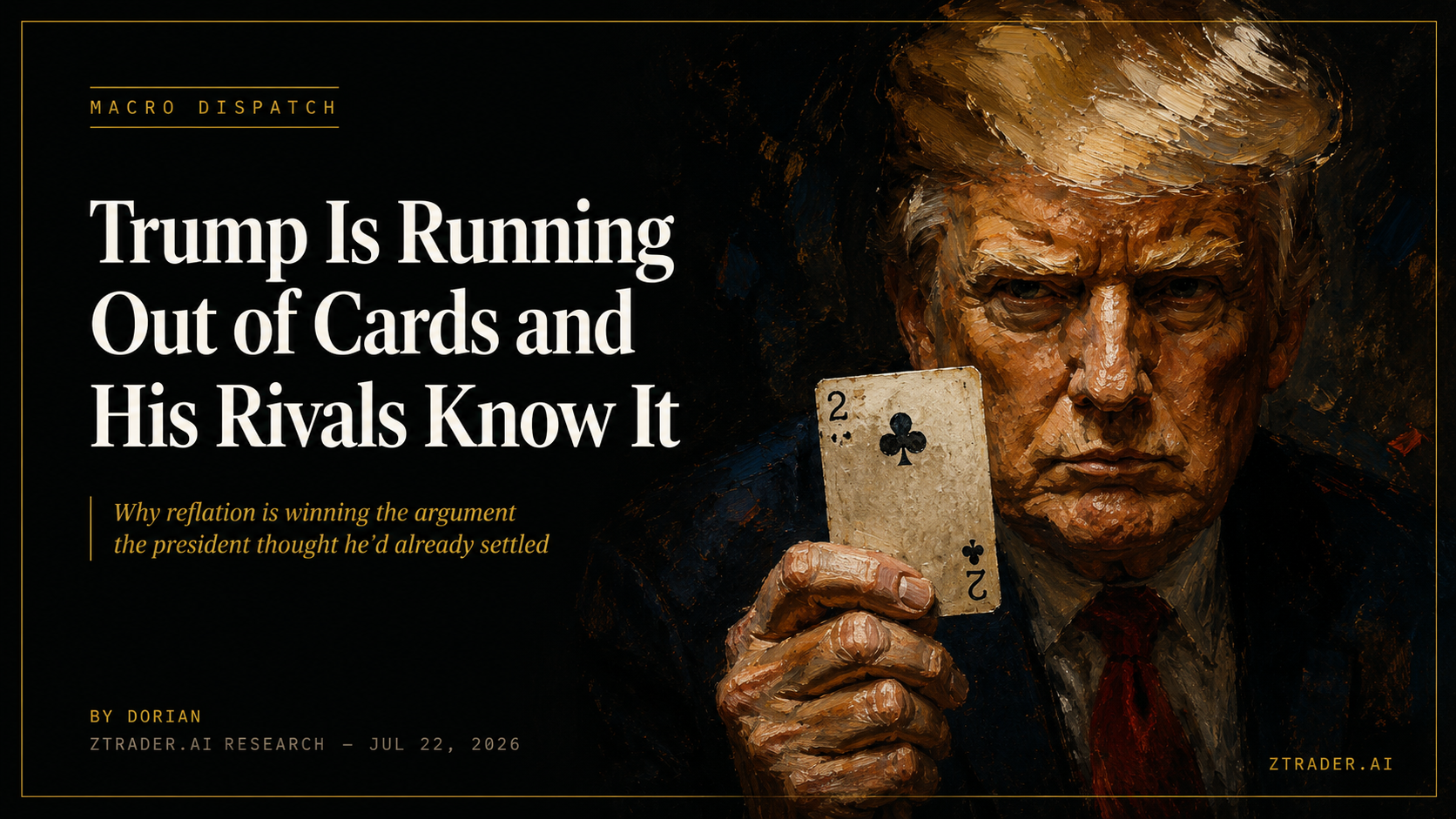
Trump Is Running Out of Cards and His Rivals Know It
Kevin Warsh was supposed to be the fix.
Trump picked him, swore him in personally at the White House on May 22, and told anyone who'd listen that this was finally a Fed chair who understood that low rates solve everything. Seven weeks later, Warsh sat through a 12-0 vote to hold the funds rate at 3.50–3.75%. The minutes, released July 8, showed the eighteen policymakers who submitted projections split down the middle — half wanted to hold or cut, half wanted a hike before year-end. Trump did not get a dove. He got a man reading the same numbers as everyone else, chairing a committee that can't agree with him or with itself.
Warsh himself has offered no forward guidance. At the ECB Forum in Sintra on July 1, he called prices "too high" and said the committee would decide on a hike within four weeks — pointing straight at the July 28–29 FOMC meeting, still ahead of this piece. CME FedWatch has priced roughly 25% odds of a hike at that meeting as of mid-July. Nothing here is resolved yet; what's resolved is that "cut" is no longer on the table in any scenario Warsh is describing.
Those numbers are the story. Headline PCE inflation hit 4.1% year-over-year in May, core running at 3.4% — both well above target — and the White House's own advisors have stopped pushing Warsh in public — giving him "space" instead of pressure, which is retreat dressed as strategy.
Warsh is early in a four-year term that runs into 2030, and inflation prints, not loyalty, are what decide whether he keeps his credibility with the bond market before then.
Here is the part Trump cannot spin away: the debt does not care who chairs the Fed. Core PCE reversed hard in the spring, and headline inflation reached 4.1% year-over-year in May — more than double the Fed's target — after briefly cooling to 2.5% in January. The tariff pass-through the administration insisted was "transitory" never fully unwound before the next leg up arrived.
Net interest on the national debt is on pace to close fiscal 2026 near $1.04 trillion — larger than the defense budget, larger than everything but Social Security and Medicare. Tariff revenue surged 220% year-over-year, from $59 billion to $190 billion through the first seven months of the fiscal year. It still is not closing the gap.
Meanwhile the politics have stopped waiting for the economics to resolve. Trump's approval sank to 38.1% in May, the low point of either term, and most July trackers — AP-NORC, NYT/Siena, Economist/YouGov — cluster around 37%. On the most closely watched independent-approval tracker, that number sits at 34%, below the 36% level that preceded the 41-seat Democratic sweep in 2018; one outlier poll (I&I/TIPP) shows Trump "turning a corner" with independents ticking up to 29% favorability in July from 25% in June, so the trend isn't unanimous, but it's the exception, not the pattern. Six special elections in 2025–26 broke an average of 15 points toward Democrats.
For the first time since 2010, voters trust Democrats over Republicans on the economy — the one issue Trump built his entire second term around fixing. His rivals do not need to attack him. They need to wait for the next PCE print.
| Indicator | Reading | Date | Signal |
|---|---|---|---|
| Fed funds rate | 3.50–3.75% | Jun 17, 2026 | Hold, 12-0; dot plot split 50/50 |
| Next FOMC meeting | Jul 28–29 | 2026 | ~25% hike odds (CME FedWatch) |
| Headline PCE (core: 3.4%) | 4.1% YoY | May 2026 | 2x target |
| Trump approval (overall) | 38.1% | May 2026 | Term low |
| Trump approval (independents) | 34%* | Jul 2026 | Below 2018 wave line* |
| Net interest on debt, FY26 | ~$1.04T | Jul 2026 proj. | Exceeds defense budget |
| Tariff revenue, FY26 (7-mo.) | $190B | Jul 2026 | +220% YoY, gap unclosed |
| Weighted avg. rate on debt | 3.41% | Jun 30, 2026 | vs. 1.47% (5yr ago) |
| Unemployment rate | 4.2% | Jun 2026 | Stable, not the constraint |