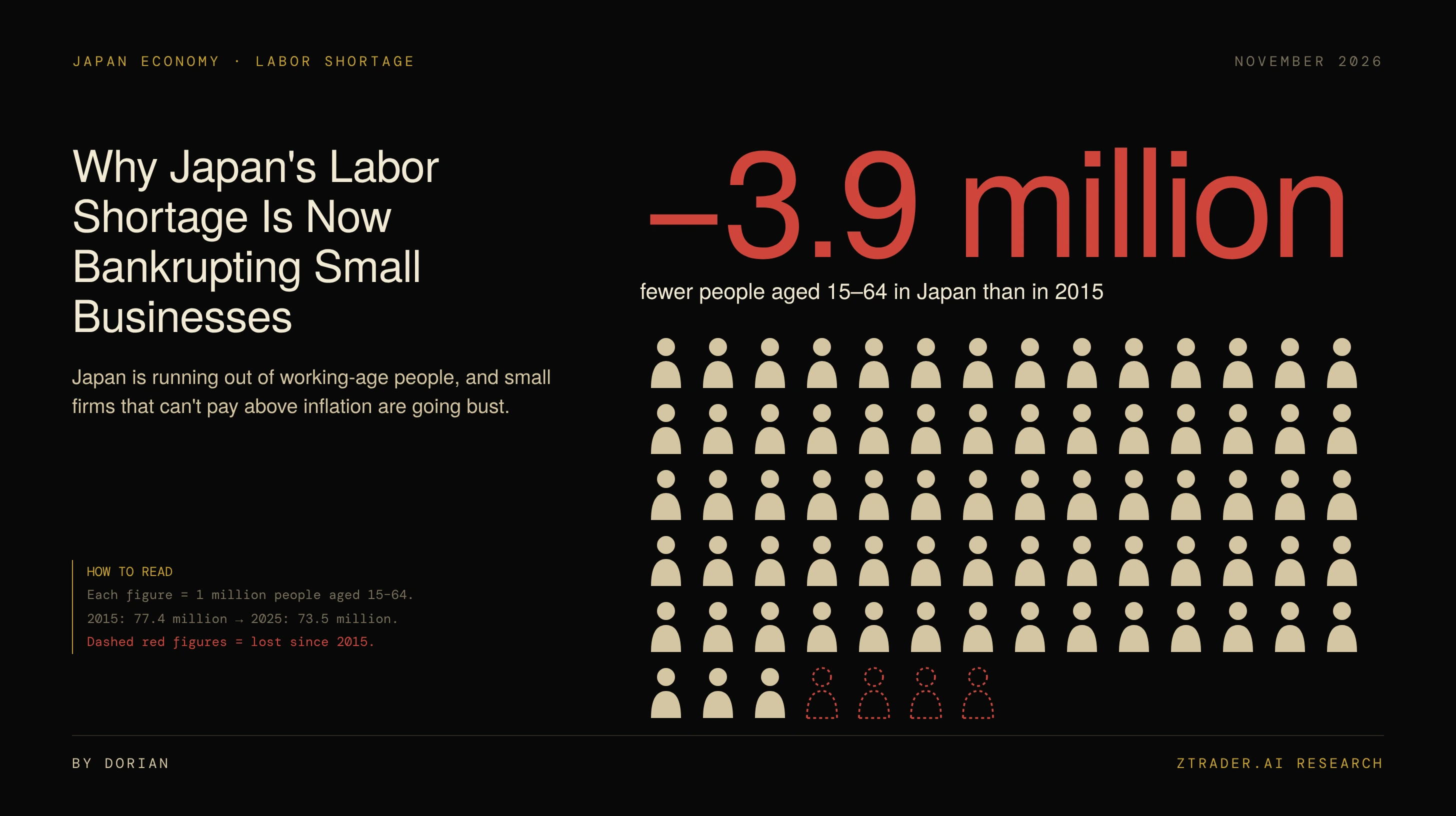
Why Japan's Labor Shortage Is Now Bankrupting Small Businesses
Japan is running out of working-age people, and small firms that can't pay above inflation are going bust.
Japan has more jobs than workers, and its working-age population will start shrinking faster from 2027.
Japanese companies are now failing for lack of workers at a record pace, even though unemployment sits at just 2.4%, and more than half of them failed because they could no longer afford the staff they had.
For most of the past three years, we treated Japan's labor shortage as good news. It pushed the spring wage round, known as shunto, above 5% for a third straight year, and it gave the Bank of Japan the wage evidence it needed to declare on October 30 that underlying inflation has reached its 2% target. The same shortage now shows up in a darker set of numbers. Labor-shortage bankruptcies have hit a record, restaurant failures have hit a record, small firms are giving raises that trail inflation, foreign business owners are leaving under tighter visa rules, and Japanese companies report the tightest staffing conditions since the early 1990s. If you trade anything tied to Japan, you should care, because the shortage now sits underneath every major Japan variable at once, from the pace of BOJ rate hikes to the yen, the JGB curve and the durability of Japan's AI investment cycle. In this piece, we trace where the shortage turned from a tailwind into a constraint, which firms and sectors are taking the damage first, why pay still trails prices, why Japan is gaining foreign labor while losing foreign capital, and why automation cannot close the gap.
IWHY COMPANIES ARE GOING BUST AT 2.4% UNEMPLOYMENT
If you only look at Japan's headline labor data, everything looks calm, and that calm is exactly what makes the corporate data so striking. The unemployment rate fell to 2.4% in September from 2.5% in August, yet both of Japan's main private credit agencies recorded more labor-shortage bankruptcies in April–September than in any April–September period since they began counting in 2013.
Tankan: The Shortage Is Near Bubble-Era Extremes
The Tankan is the Bank of Japan's quarterly survey of Japanese companies. Its employment conditions DI takes the share of firms that report excess staff and subtracts the share that report a shortage, so the deeper the negative reading, the harder it is for companies to hire.
September survey: The DI for all firms fell to -38 points from -37 points in June, which matches the most severe reading in 34 years, first recorded in December 2025.
Company size: Large firms reported -29 points, mid-sized firms -38 points and small firms -42 points, so the smaller the company, the worse the shortage.
December outlook: Companies expect the DI to reach -41 points overall and -45 points for small firms, which would be the tightest reading since the early 1990s.
Bankruptcy Data: Two Agencies, Same Trend
Tokyo Shoko Research (TSR) and Teikoku Databank (TDB) both track legal bankruptcies with liabilities of at least ¥10 million, and they assign each case a cause. They classify causes slightly differently, so their counts differ, but their trends match.
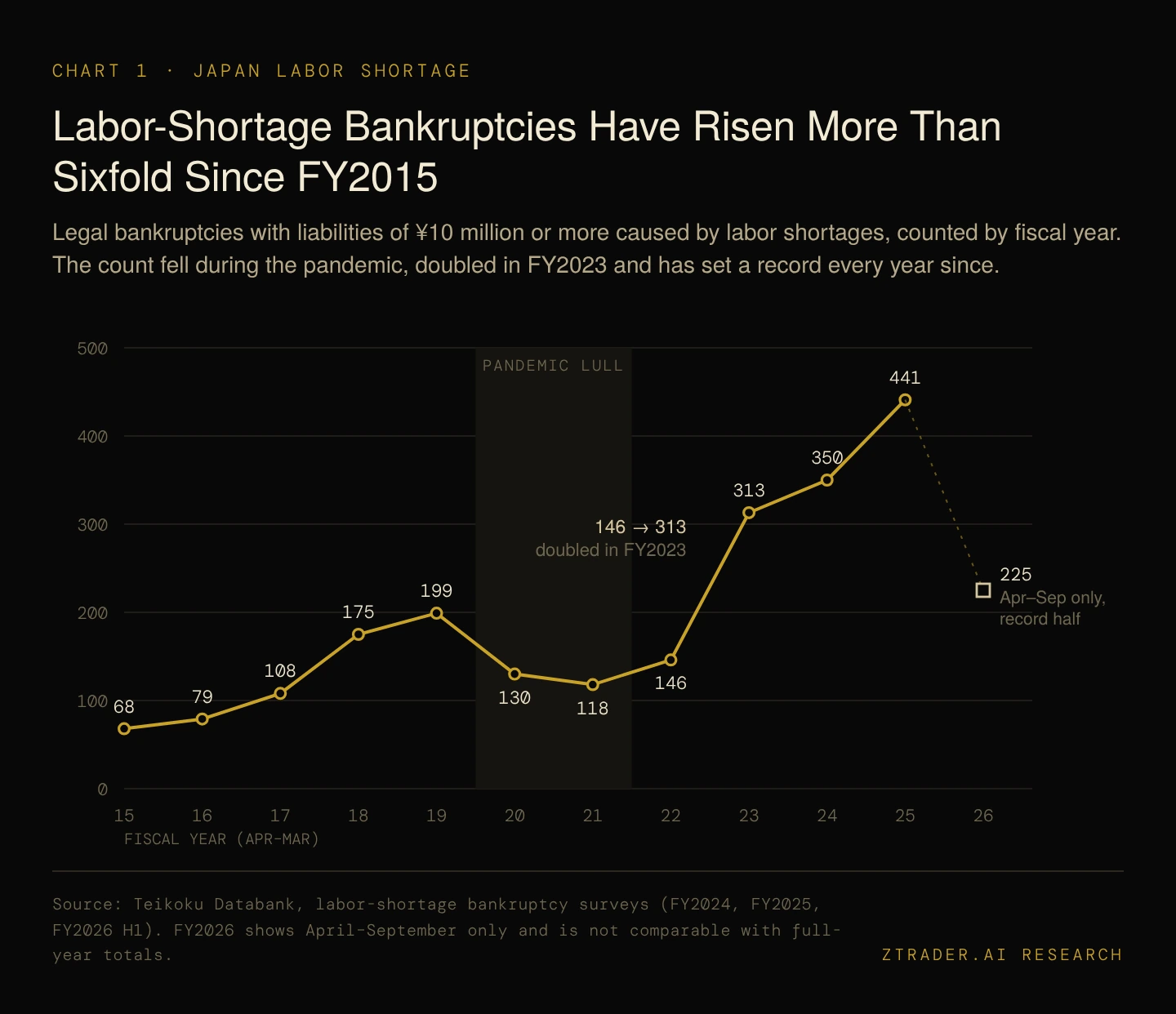
TSR: TSR counted 240 companies that went bankrupt because of labor shortages in April–September 2026, up 17.0% from 205 companies a year earlier. Its count has now risen for five straight years from a low of 26 companies in the same period of 2021.
TDB: TDB counted 225 companies, up from 214 a year earlier, and its count has set a record for four consecutive years.
Full fiscal year 2025: TDB counted 441 labor-shortage bankruptcies in the year to March 2026, roughly 1.3 times the 350 it recorded the year before.
You should keep these 240 companies in proportion. TSR recorded 5,373 bankruptcies across Japan in the same six months, so labor shortages were the main cause in about 4.5% of cases, compared with 436 cases blamed on rising prices. The labor-shortage count still matters for two reasons. It has set a new record in each of the past five years, and TSR assigns each bankruptcy a single main cause, so a firm that lost its staff and then ran out of cash may show up under a different heading.
Inside the 240: Labor Costs Now Lead the Count
So how exactly is the shortage killing these companies? TSR splits the cases into three causes, and the split tells you more than the total.
Rising labor costs: Rising labor costs brought down 130 companies, up 75.6% from 74 a year earlier, and this cause now accounts for 54.1% of the total.
Employee departures: Staff quitting brought down 67 companies, up slightly from 65.
Failure to recruit: The inability to hire brought down 43 companies, down 34.8% from 66.
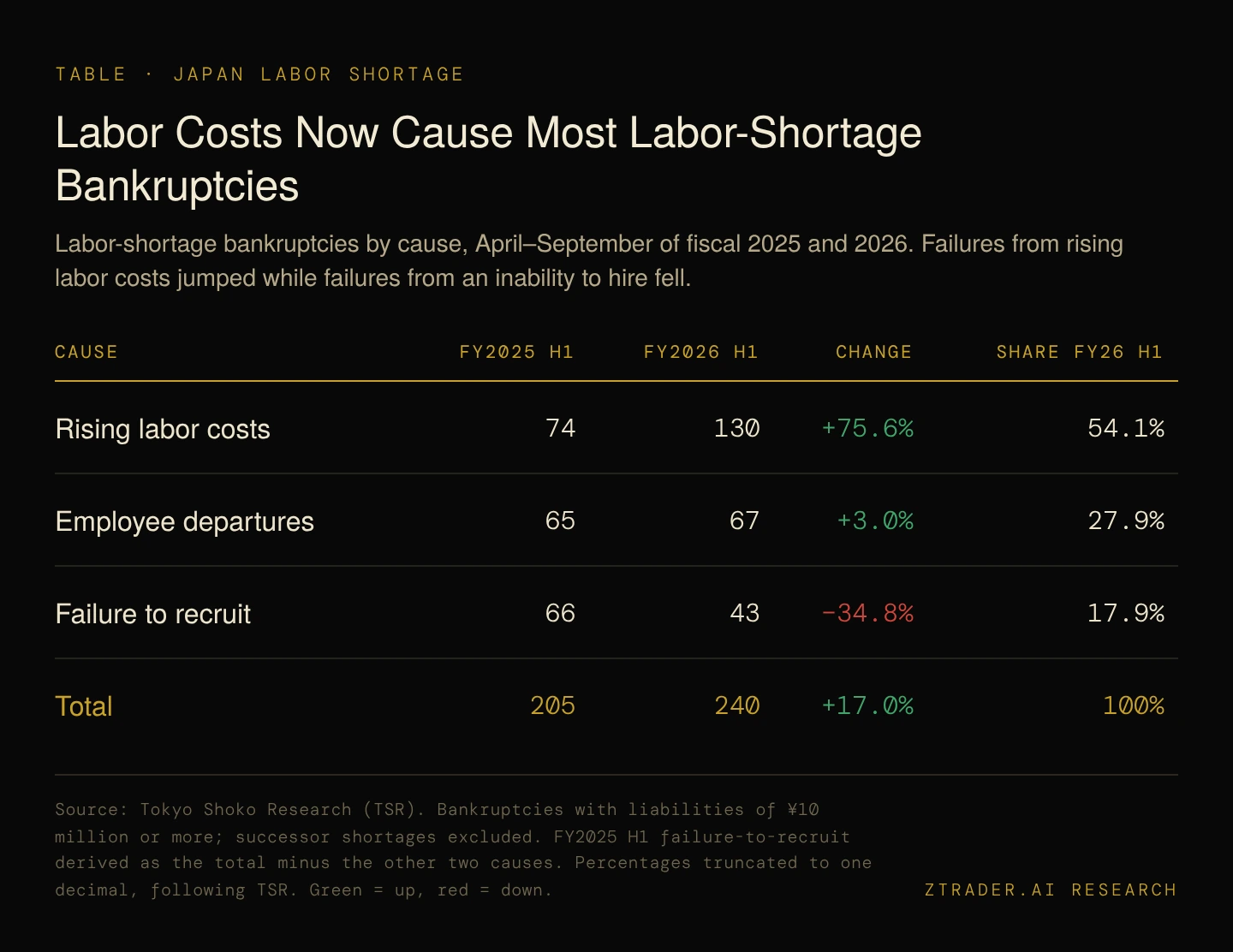
Companies that simply cannot find anyone now make up a shrinking share of these failures. The growing share are companies that did find workers, raised pay to keep them and ran out of cash doing it, which TSR calls "wage-hike fatigue." In other words, the shortage has moved from the hiring stage to the income statement.
IITHE JOB OPENINGS RATIO IS HIDING THE REAL PROBLEM
If the shortage were getting worse because demand for workers was booming, you would expect Japan's best-known measure of labor demand to be climbing. It has drifted lower over the past year instead, and the reason for that gap is the core of this story.
What the Ratio Counts
The jobs-to-applicants ratio divides the number of open jobs listed at Hello Work, Japan's network of public employment offices, by the number of registered job seekers. At a ratio of 1.18, Japan has 118 open jobs for every 100 applicants.
2026 readings: The ratio fell to 1.17 openings per applicant in May, held at 1.18 through the summer and edged up to 1.19 in September.
One year earlier: It stood at 1.20 in September 2025, which was already its lowest level since January 2022.
So the demand gauge is lower than it was a year ago, while the Tankan shortage has deepened. When companies report a worsening shortage at the same time as openings per applicant edge down, the pressure is coming from the supply of workers. Japan is running short because the pool of available people has stopped growing.
Participation Has Done All the Work
Japan's labor force crossed 70 million people for the first time in 2025, reaching 70.04 million, and the way it got there tells you why the next decade will look different. From 2015 to 2025, the labor force grew by 3.79 million people while the population aged 15–64 fell by about 3.9 million, so every additional worker came from higher participation. Workers aged 65 and over supplied more than half of that increase, or 2.13 million people.
Women: Japanese women already take part in the labor market at rates on par with the Nordic countries.
Older workers: Japanese people aged 65 and over have the second-highest labor participation rate in the OECD, behind only South Korea.
These two groups carried a decade of employment growth, and both of them are now close to their limit.
The Demographic Step-Down From 2027
Japan recorded 671,236 births in 2025, according to preliminary health ministry data, and the effect of earlier declines in births is about to reach the workforce. Recruit Works Institute projected in March 2023 that Japan's working-age population will begin falling rapidly from 2027 and that the supply of workers will be about 12% lower in 2040. That decline would leave Japan more than 11 million workers short, even if labor demand stays flat. The researchers assumed almost no economic growth, so any real expansion would widen the gap further.
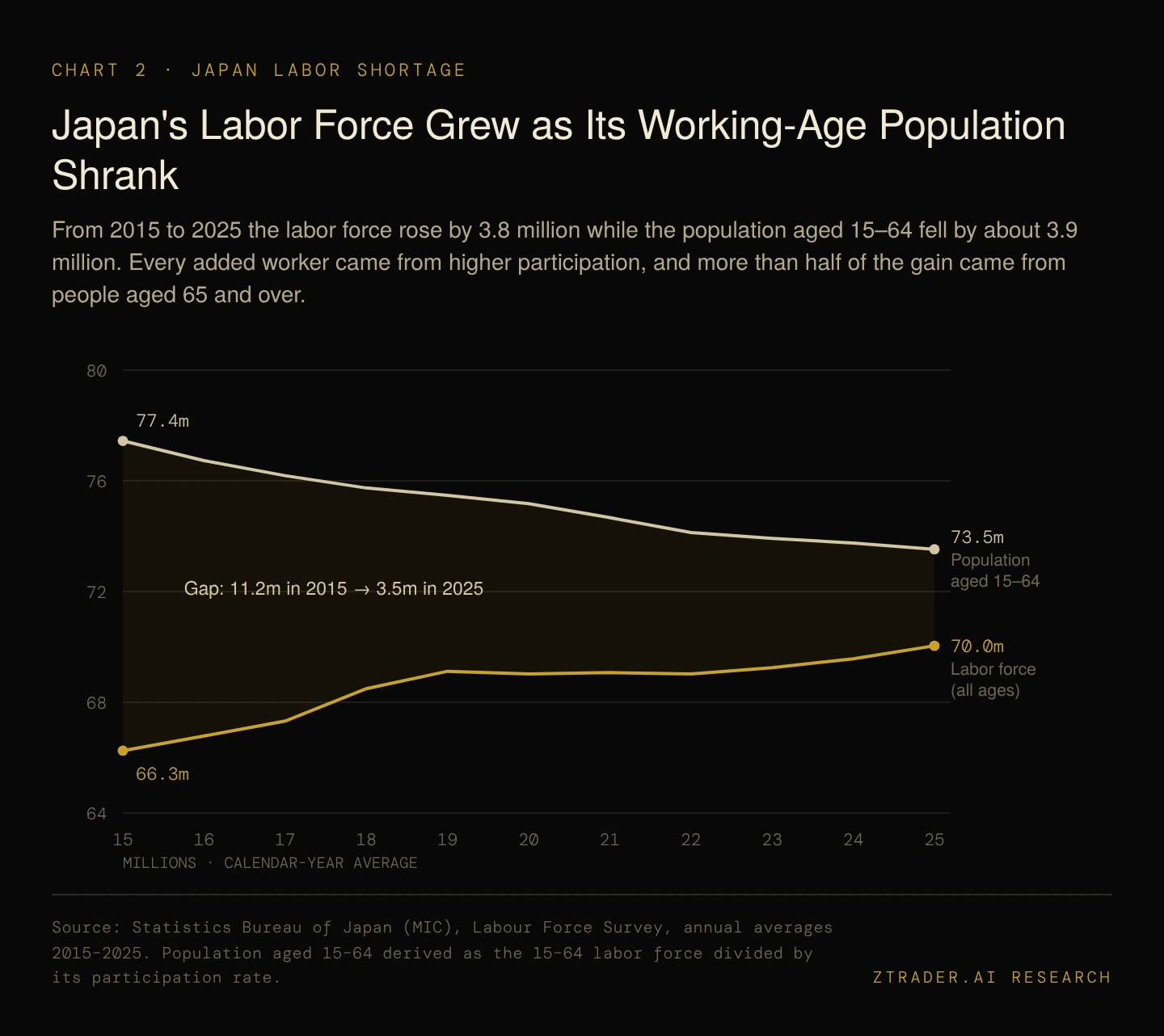
Japan has used up its easy sources of new workers just as its population curve turns down harder.
IIIWHO GETS HIT FIRST: CONSTRUCTION, SERVICES AND SMALL FIRMS
The damage is concentrated in labor-intensive industries and in small companies, and that concentration shows you where the constraint will spread next.
Construction: Bankruptcies and Failed Tenders
Construction had more labor-shortage bankruptcies than any other industry in TDB's April–September count, with 70 companies, 17 more than a year earlier. The same shortage is stalling public works. In a Japan Research Institute survey of municipalities conducted in January and February 2026, more than 90% of respondents said at least one construction tender had failed to find a contractor over the past three years, and 72.3% said four or more had failed. They blamed budgets that no longer cover material costs and contractors that cannot staff the job. Building costs have kept rising under that pressure, and the Construction Research Institute's index stood above 150 in January 2026, against a 2015 base of 100.
Services and Software
Service companies accounted for 63 labor-shortage bankruptcies in TDB's count, 6 more than a year earlier, and TSR finds that services and construction together made up 60.8% of its 240 cases. TDB also flagged a jump among contract software developers, from 2 companies to 8, as smaller firms failed to hire the engineers they needed to keep up with AI and other new technology.
Small Firms Versus Large Firms
The size gap in the Tankan, -42 points for small firms against -29 points for large ones, shows you that the shortage bites hardest where companies have the least room to pay their way out of it. Small firms are also absorbing a higher legal pay floor. The national weighted-average minimum wage is ¥1,177 an hour for fiscal 2026, and the new prefectural rates take effect from October onward. TSR expects labor-shortage bankruptcies to keep rising because small firms face exactly this combination of higher prices and higher labor costs.
Large firms can outbid everyone for workers, and small firms are being priced out of keeping their own staff.
IVRESTAURANTS ARE CLOSING AT A RECORD PACE
If you want to see the shortage at street level, look at restaurants. No restaurant can open without enough people on the floor and in the kitchen, and the industry is now going bankrupt at a record pace.
Record Failures in the First Half of 2026
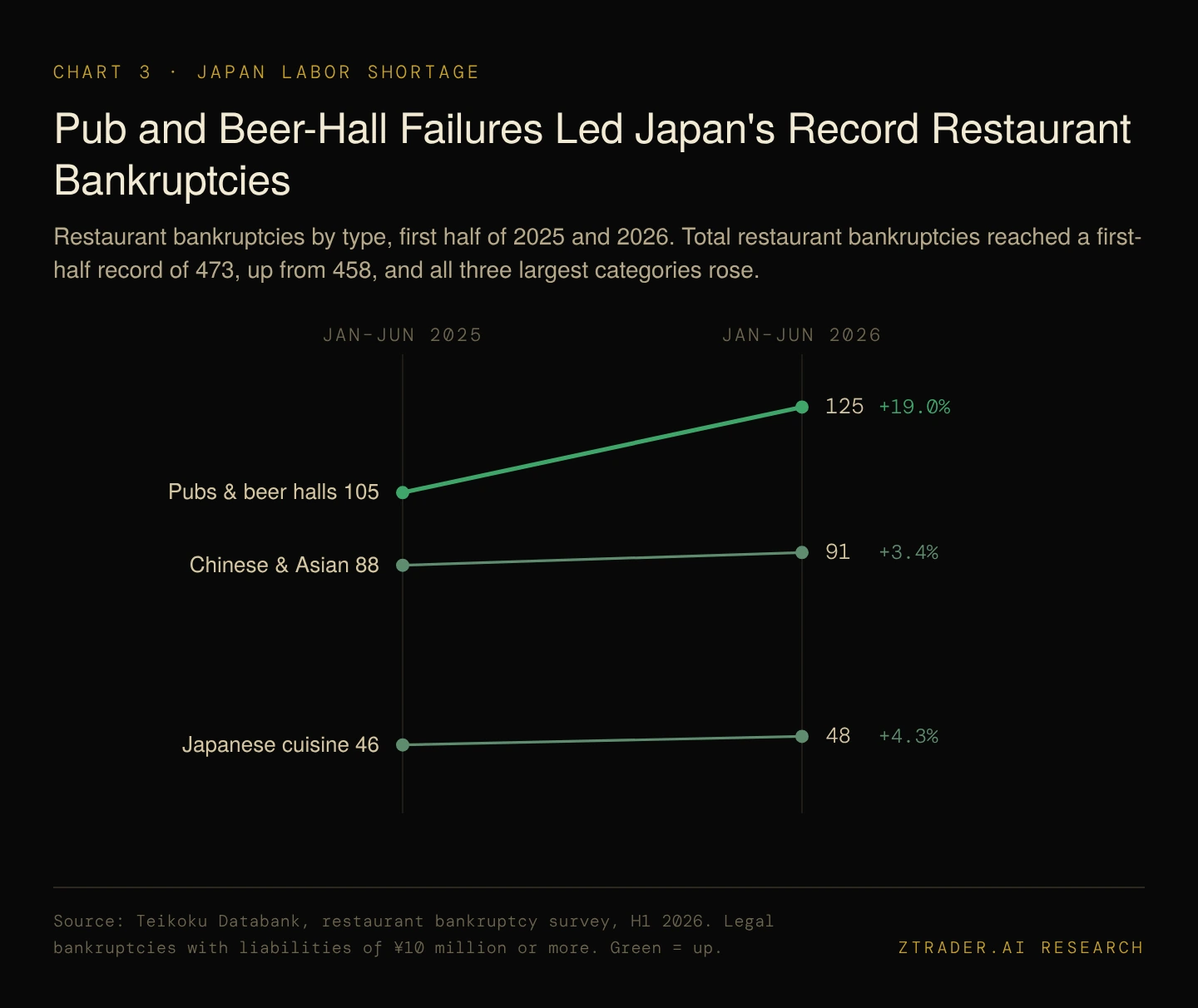
TDB and TSR count restaurant bankruptcies with slightly different scopes, and both of them now report the worst first half on record.
TDB: TDB counted 473 restaurant bankruptcies in January–June 2026, up from 458 a year earlier, the fourth consecutive annual increase. Bankruptcies among pubs and beer halls rose to 125 businesses from 105, and 78% of all restaurant bankruptcies involved liabilities under ¥50 million.
TSR: TSR's broader food-service count reached 509 businesses, the first time a first-half total has topped 500 since 1997. TSR attributed 36 of those failures to labor shortages, more than double the year before, and 90.5% of the failed businesses had capital under ¥10 million, including sole proprietors.
Policy: TDB names the staff shortage as a central problem for the industry. It also points to the April 13 suspension of new Specified Skilled Worker admissions for food service, which closed the visa route that restaurants had been using to hire foreign staff.
Scheduling Software Cannot Schedule Workers Who Do Not Exist
Restaurant owners have been sold a technology answer. Japanese software vendors now market AI shift-scheduling tools to restaurants, retailers and care homes, and they promise rosters built in minutes from staff availability and demand forecasts. The wider market for attendance and work-management software is growing fast. Research firm ITR put the market at ¥32.8 billion in fiscal 2022, about four times its size a decade earlier, and it expects the market to grow 14% a year through fiscal 2027, with cloud subscriptions making up about 80% of it by fiscal 2025.
So can software fix the problem? These tools solve an allocation problem. They move the same hours around more efficiently, cut the manager's paperwork and spot the gaps in next week's roster sooner, but they cannot fill those gaps. If a restaurant has six people for a shift that needs nine, a better algorithm gives you a cleaner schedule with the same three empty slots, and the owner still has to cut opening hours, close one day a week or shut the business. The record bankruptcy count tells you which of those outcomes is becoming more common.
Scheduling software can ration labor, but it cannot create it.
VPAY IS RISING, SO WHY ARE JAPANESE WORKERS POORER?
Japanese headline wage growth has looked strong for three years, and that headline hides the main reason small firms cannot hire. Once you take prices out, Japanese pay has gone backwards.
Four Years of Real Pay Cuts
The health ministry's Monthly Labour Survey measures pay at workplaces with five or more employees. Its real wage series adjusts that pay for consumer prices, excluding the imputed rent of owner-occupied homes.
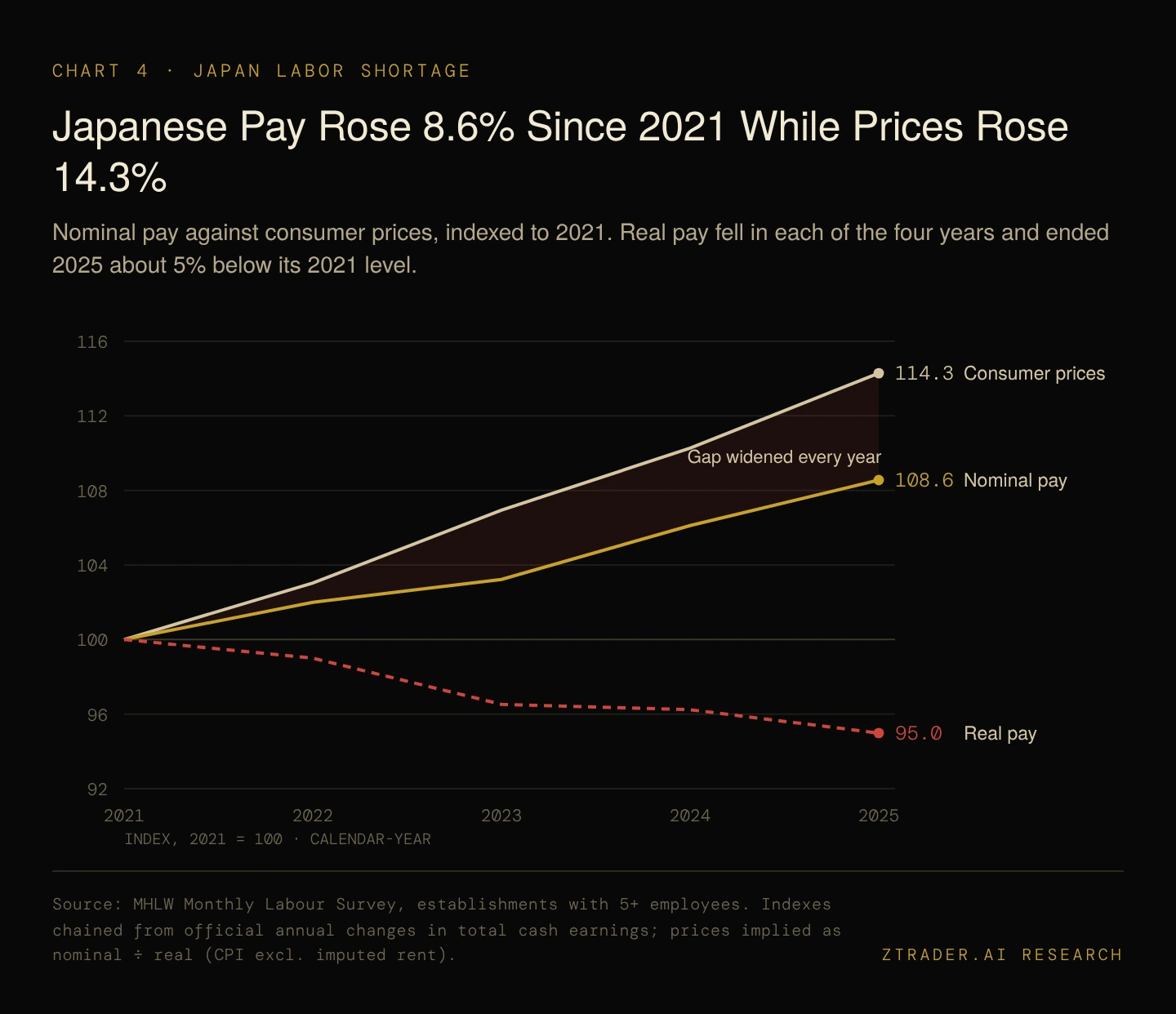
2022–2025: Japanese real wages fell in each of the four years, by 1.0%, 2.5%, 0.3% and 1.3%.
Cumulative gap: When we chain the official annual changes together, nominal pay rose about 8.6% from 2021 to 2025, while consumer prices rose about 14.3%. Real pay therefore ended 2025 about 5% below its 2021 level.
2026: Real wages have turned positive month by month this year, and preliminary data show August up 1.5%. That gain arrived alongside the government's inflation-relief measures, and it wins back only part of the ground workers lost since 2021.
Token Raises at Small and Mid-Sized Firms
The national average hides where the damage sits. The health ministry's 2025 wage census shows that average monthly wages rose 5.7% at large firms, 2.1% at small firms and 1.0% at mid-sized firms. Consumer prices rose about 3.6% in 2025, so only workers at large firms came out ahead. If you worked at a mid-sized firm, you took a real pay cut of roughly 2.6%, and if you worked at a small firm, you took a real pay cut of roughly 1.5%.
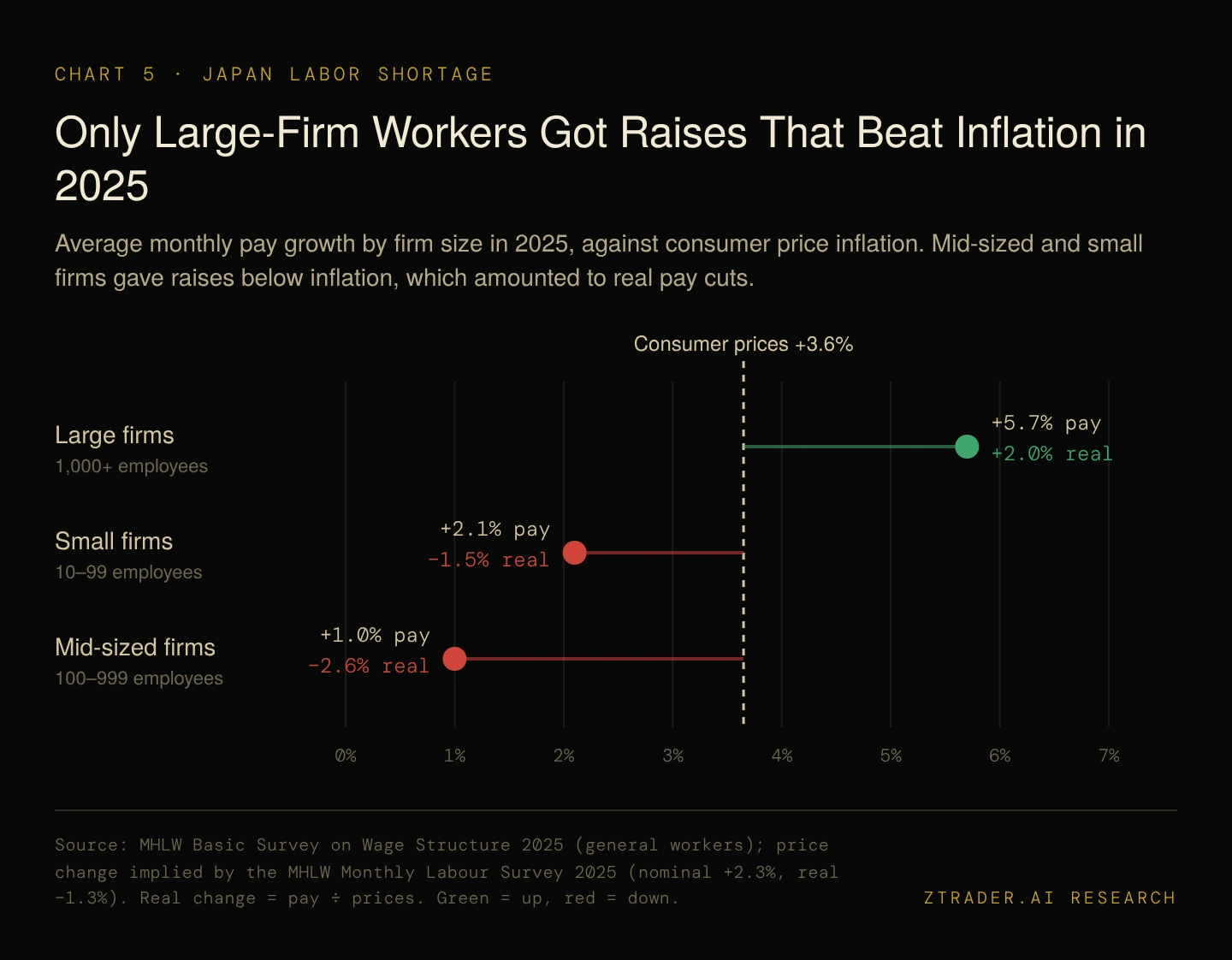
This is where wage stagnation and the labor shortage meet. So why can't small firms just pay more? They can't afford to. Small firms cannot offer pay that keeps up with prices, so they lose staff to large firms and struggle to hire replacements. The ones that do raise pay enough to compete often run out of cash, which is why rising labor costs now cause 130 of TSR's 240 labor-shortage bankruptcies.
Japan's wage gains are concentrated in a few large employers that are outbidding everyone else for a shrinking pool of workers.
VIJAPAN LETS IN WORKERS WHILE PUSHING OUT BUSINESS OWNERS
If Japanese workers are running out, you would expect foreign workers to fill the gap. They have been Japan's main outside source of new labor, and their numbers have grown fast enough to matter for the whole economy. The policy tightening of the past year, however, is now changing which foreigners come to Japan and which ones leave.
Scale: Japan had 2,571,037 foreign workers at the end of October 2025, up 11.7% from a year earlier and a record for the 13th consecutive year.
Share: Foreign workers make up roughly 3.8% of Japan's workforce, and their number is nearly triple the 900,000 recorded in 2015.
Contribution: Japan added 268,450 foreign workers in the year to October 2025, which equals more than half of the 470,000-person rise in total employment in 2025.
What the Headline Count Measures
Japan counted a record 4,281,026 foreign residents at the end of June 2026. That count includes only mid- to long-term residents and special permanent residents, and it excludes tourists and other short-term visitors, so the record reflects people who actually live and work in Japan. The total, however, hides a split by visa type.
Business Owners Are Leaving
From October 16, 2025, Japan tightened the Business Manager visa, which foreigners use to set up and run companies in Japan. The government raised the capital requirement from ¥5 million to ¥30 million, and it now requires each business to employ at least one full-time worker who is Japanese or a permanent resident.
Holders: The number of Business Manager residents fell 8.6% in six months, from 46,781 people at the end of 2025 to 42,747 at the end of June 2026. Business Manager was the only major work-related visa status to shrink.
Departures: In the first half of 2026, 953 Business Manager holders left Japan without a re-entry permit, 3.9 times the 246 people who did so a year earlier.
Everyone else: Over the same six months, the number of Specified Skilled Workers rose 13.8%, engineers and specialists rose 8.5%, and highly skilled professionals rose 4.6%.
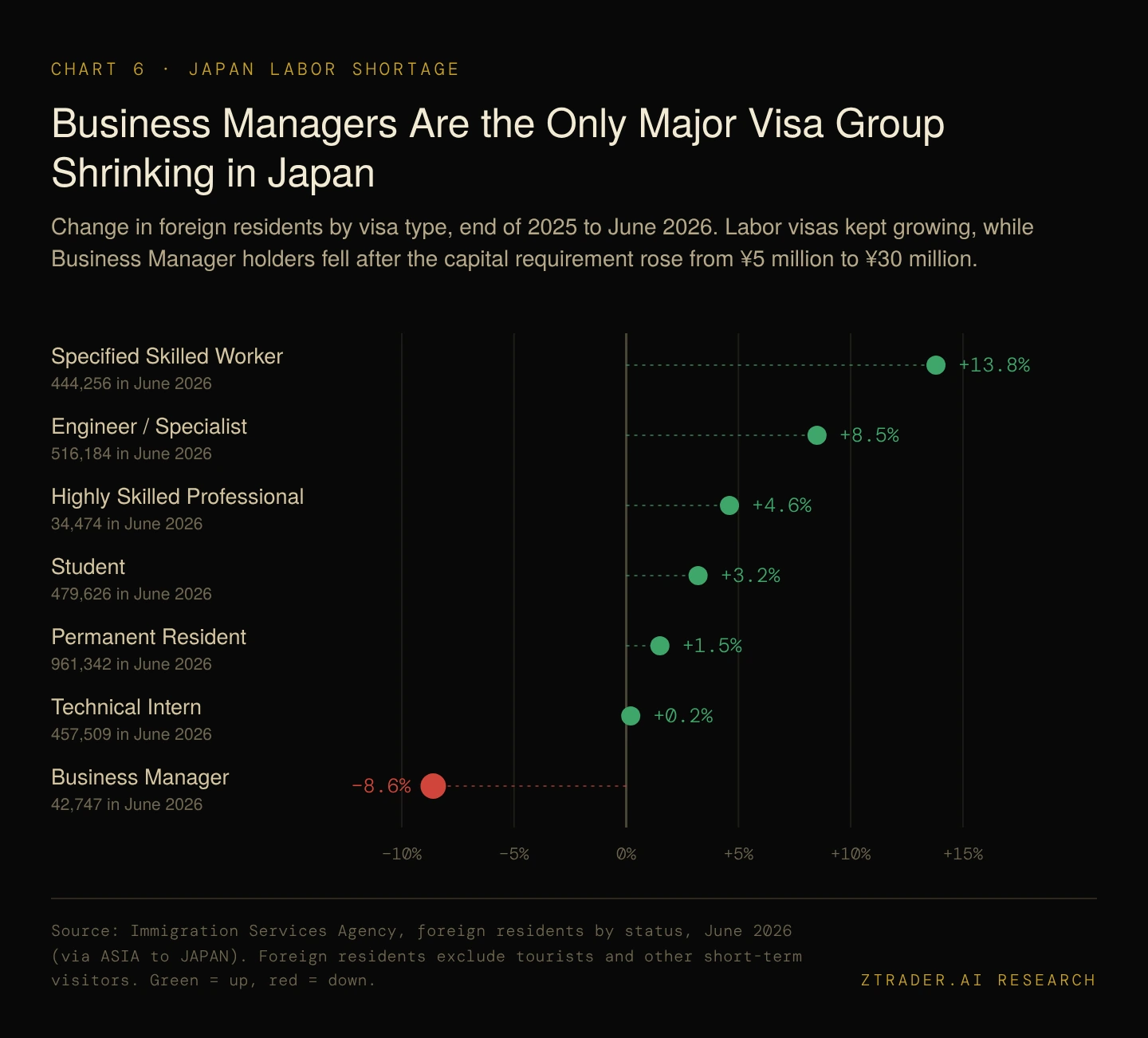
Japan is losing the foreigners who bring capital and create jobs, while the foreigners who are still arriving fill existing jobs at the lower end of the wage scale.
The Labor Channel Is Narrowing Too
Foreign worker growth slowed from 12.4% the year before, and three forces are now squeezing this channel at the same time.
- The weak yen: By mid-June 2026, Vietnam had sent nearly 28,500 workers to Japan and about 28,200 workers to Taiwan, according to figures reported by Dan Tri. Japan still ranks first, but Vietnamese officials say the yen's fall has made Japan less attractive.
- Public opinion: In the University of Tokyo Institute of Social Science panel survey, 56.3% of respondents in 2026 opposed admitting more foreigners who intend to settle in Japan, up from 35.6% in 2024.
- Policy: The government is moving to add Japanese-language and income requirements for permanent residency. It also suspended new Specified Skilled Worker admissions for food service from April 13, 2026, after the sector approached its cap of 50,000 workers.
Japan is still adding foreign workers, but it is pushing out foreign employers and closing the door on the industries that need staff most.
VIICAN AI AND AUTOMATION REPLACE MISSING WORKERS?
When companies cannot hire, they invest in machines and software to replace the hours they cannot staff. The third-quarter GDP report due on November 16 will show you how far that substitution has gone.
Q3 GDP: Capex Up, Consumption Down
ITOCHU Economic Research Institute's estimate shows an economy split between business investment and households.
Headline: ITOCHU estimates that real GDP grew 0.3% from the previous quarter, or 1.4% at an annualized rate.
Business investment: It estimates that business investment rose 3.6%, its first gain in three quarters, driven by AI data centers, IT equipment and labor-saving technology that companies are installing to cope with worker shortages.
Private consumption: It estimates that household spending fell 0.1%, a second straight quarterly decline.
Housing investment: It estimates that housing investment fell 2.9% as higher interest rates weighed on construction.
The Tankan tells you the same story from the corporate side. Its business conditions index for all firms rose to +21 points in September, the highest level since 1991, while the employment DI sat at -38 points. Japanese companies have the demand, but they lack the people to serve it.
Why Households Are Not Spending
Household spending is estimated to have fallen for two quarters, and the wage data explains why. Japanese households still have about 5% less purchasing power than they had in 2021, and this year's real gains depend partly on government inflation-relief measures. The biggest pay rises sit in large firms, while the cost squeeze and the bankruptcies sit in small companies, which provide seven out of every ten jobs in Japan. The households that work for the firms under the most pressure are the ones least likely to feel any recovery.
Fiscal Spending Meets a Capacity Limit
Prime Minister Sanae Takaichi's government plans to cut the consumption tax on food from 8% to 1% for two years from April 2027, which will cost roughly ¥5 trillion a year in lost revenue, and it is also pushing for more public investment. The failed municipal tenders show you the risk in that plan. The government can approve spending faster than contractors can staff the projects, and when construction capacity is the limit, extra spending tends to push up building costs more than it adds output.
Labor now sets the speed limit for Japan's growth, and both private investment and fiscal policy are running into it.
VIIIJAPAN'S GROWTH HAS RUN INTO A LABOR CEILING
Japan's labor shortage has turned from a wage tailwind into a binding constraint, and we can trace it to five causes. First, participation among women and older workers is already near its ceiling, so Japan can no longer grow its labor force by pulling more people in. Second, Japan's working-age population will begin a steeper decline from 2027. Third, small and mid-sized firms cannot raise pay faster than prices, so they lose staff to large employers, and the ones that try now account for most labor-shortage bankruptcies. Fourth, restaurants are going bankrupt at a record pace, and scheduling software can only ration the hours that remain. Fifth, Japan's immigration policy is admitting lower-wage labor while pushing out foreign business owners and shutting the food-service hiring channel. What you get is an economy in which companies have demand they cannot staff, businesses invest in machines while households cut spending, and government spending runs into the limits of construction capacity. That is why the shortage now decides how far the BOJ can raise rates, why the yen now matters for Japan's labor supply as well as its inflation, and why Japan's growth depends on an AI investment cycle that the market is already questioning.
What this means for the BOJ's December decision, the yen, the JGB curve and Japanese equities, with the dates and levels to watch, is in the members' edition on Knowledge Planet (知识星球): [LINK]