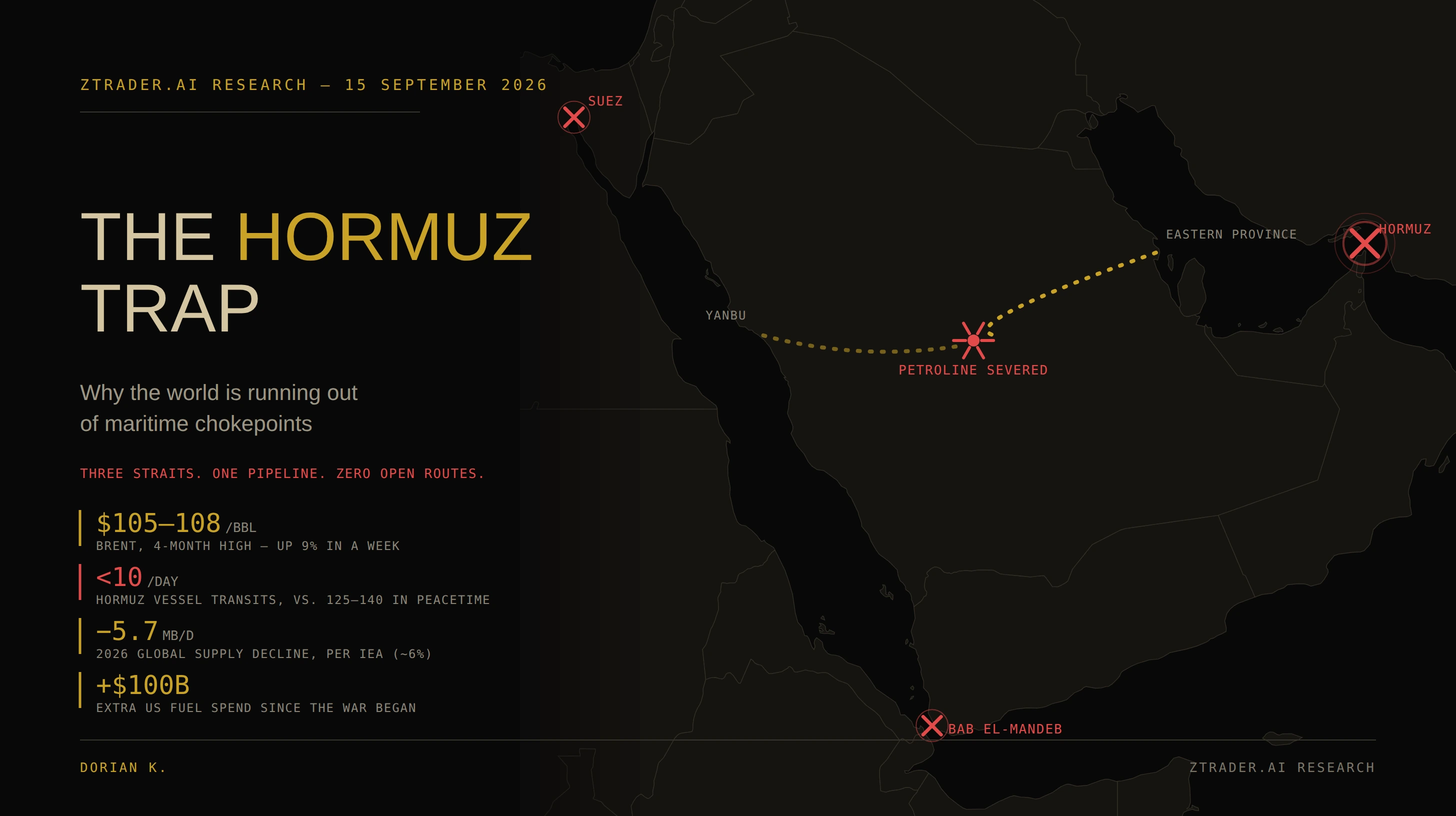
THE HORMUZ TRAP
Why the world is running out of maritime chokepoints
From my previous writing (published a couple of months ago) I WARNED THAT TRUMP WAS STEPPING INTO THE TRAP. AND THERE WAS NO QUESTION THE IRAN WAR WOULD RE-ESCALATE.
→ CLICK HERE to read my previous article.
The Hormuz choke problem eased for a while — until Trump realized it wasn't easing anymore. It looked like the kind of problem that could be resolved diplomatically. Until now.
THE HORMUZ CHOKE WAS THE LEVERAGE — A SUPER-LEVERAGE THAT IRAN CAN MONETIZE AND USE TO FORCE THE US TO DO WHATEVER THEY WANT. AND THEY HAVE SUCCESSFULLY PROVED IT TO THE WORLD, AGAIN AND AGAIN.
Trump's team thought this could be easily resolved as long as they kept more benefits on the table — or under it — but they seem to have forgotten their rival was not one to be negotiated with, no matter how good Trump claims to be at the art of the deal.
The most fatal mistake anyone can make in the global geopolitical arena is to expect people to follow the rules — acting out of pure naivety and ignorance of your rival's true capability.
Bab el-Mandeb was the next bet on the table, and it kept changing hands.
By now, this is no longer just a supply-disruption issue — it's the total failure of US Middle East strategy. The skyrocketing oil price is the result of that failure, not the symptom.
Brent closed above $105 this week, but global investors and traders have their attention tied entirely to the oil price — and have lost sight of the bigger picture, even the entire map.
Headlines and narratives are merely trying to ease rising global attention. World leaders are, in fact, far more nervous than they appear.
This is what the media is trying to divert your attention from:
FOR THE FIRST TIME IN MODERN OIL-TRADE HISTORY, TWO OF THE WORLD'S THREE MAJOR MARITIME CHOKEPOINTS ARE SIMULTANEOUSLY HOSTILE — AND THE ONE OVERLAND WORKAROUND JUST GOT DRONE-STRUCK INTO A BONFIRE.
AND YET NO ONE REALLY TALKS ABOUT IT. READERS ARE STILL OBSESSED WITH THE JAPAN DOOMER STORY.
Let's break down the math behind the Middle East conflict:
THE WAR THAT WON'T STOP
ROUND TWO OF THE WAR HAS JUST STARTED. SOON, TRUMP WILL FIND OUT EVERYTHING IS GOING TO SPIN OUT OF ORDER — OUT OF HIS CONTROL.
AND THE FRAGILE DOLLAR ORDER WILL FURTHER UNRAVEL.
QUICK RECAP HERE:
The US-Israel war on Iran started February 28.
The war got worse, then in June came a temporary deal — a preliminary US-Iran agreement to reopen Hormuz. From that point, the US didn't force Iran to reopen it; Washington all but begged (spun, of course, as a "hard bargain").
Goldman, sensing the peace deal, cut its Brent forecast to $75-80 for 2027 and called for a return to oversupply by autumn. Fitch even penciled in a 4-million-barrel-a-day glut by Q4.
That peace deal was the act — a short "fix" to show the world the US was "taking care" of the matter — but in reality, things got far worse. This act is something Trump's team is particularly good at.
President Trump is very good at "negotiating," even when he puts the entire country's odds on the table — as long as the bets aren't coming out of his own pocket.
The world is going to pay dearly for his SHORT-TERM FIX (THE PEACE DEAL).
Or, at best, it's on life support — in a Salalah conference room nobody's allowed into anymore. Oman postponed this week's regional meeting "in the interests of consensus," which is diplomat-speak for "everyone's yelling and nobody's coming."
The conflict continued. Iran re-tightened the noose on Hormuz, and the entire world felt the pressure.
And then — the actual news this week — Yemen's Houthis, in a Revolutionary-Guard-choreographed coastal blitz, took the port of Mokha on September 10 and Perim Island the very next day, giving them what analysts are calling effective control of the Bab el-Mandeb Strait.
Saudi-flagged vessels are now barred from transit, according to the Houthi military spokesman.
Just to round out the week, drones launched from Iraq hit Saudi Arabia's East-West Pipeline — Petroline, the 1,200km, 7-million-barrel-a-day lifeline that lets the Kingdom export crude without going anywhere near Hormuz.
It's been shut since September 10. Nobody, including Aramco, will say when it comes back.
Three separate points of failure.
All within 96 hours of each other.
THE CHOKEPOINT MATH
Here's the part that should actually worry global investors — serious traders shouldn't just look at the headlines and narratives.
THINGS ARE NOT OKAY.
THINGS HAVE GONE BAD, TERRIBLY BAD.
Individually, any one of these three failures is a bad week for Saudi Arabia. Together, they're something the modern oil market has genuinely never priced: a producer with zero open export corridors.
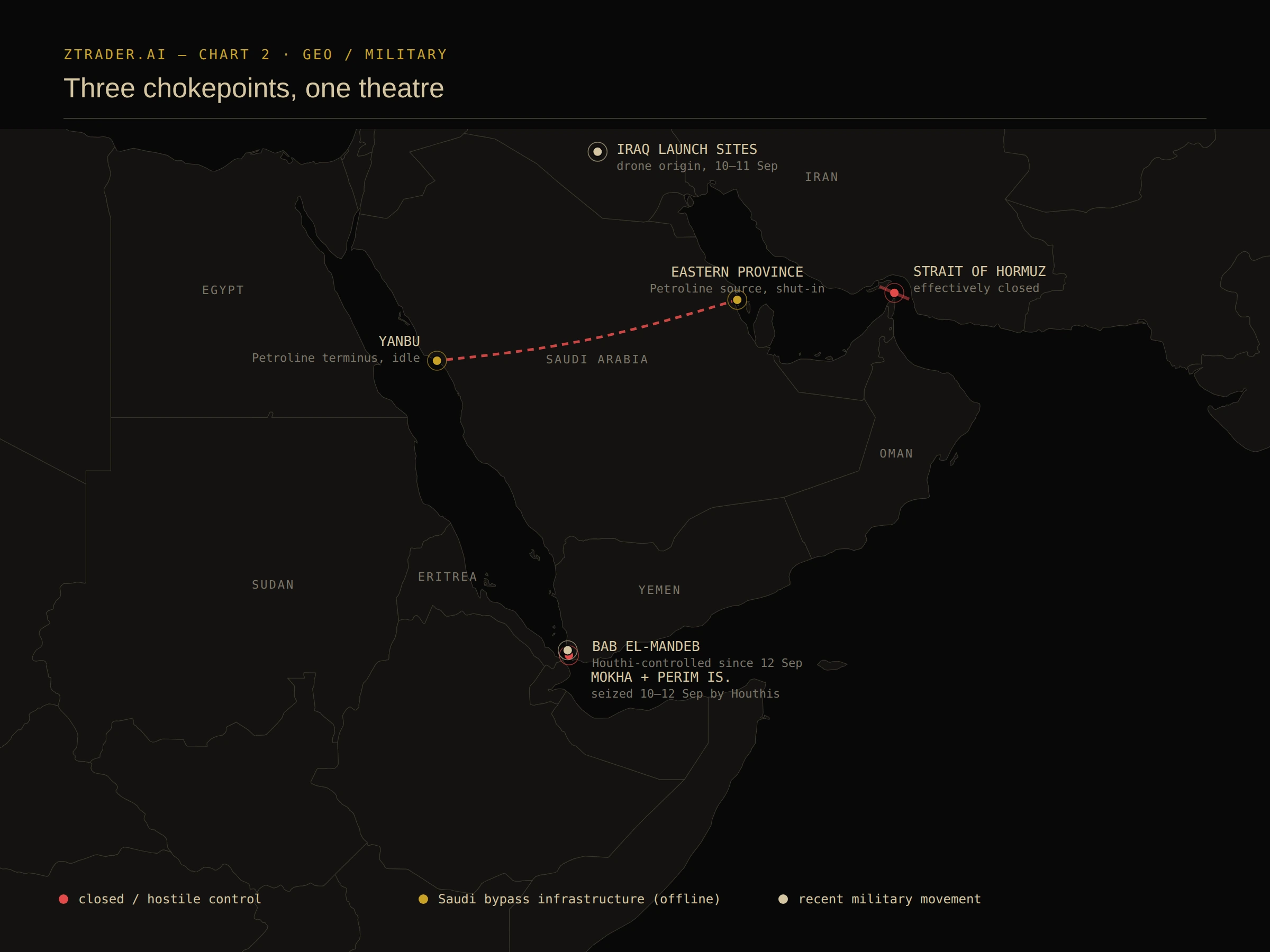
Hormuz has been functionally closed since Iran expanded its naval presence in late August — commodity vessel transits fell to single digits over the weekend, down from roughly 125-140 a day in peacetime. Bab el-Mandeb, which normally carries about 12% of global seaborne trade, is now sitting under the guns of a group that just told Saudi shipping to stay out. And Petroline — the pipeline that exists specifically as the "in case Hormuz closes" insurance policy — is currently insurance nobody can collect on.
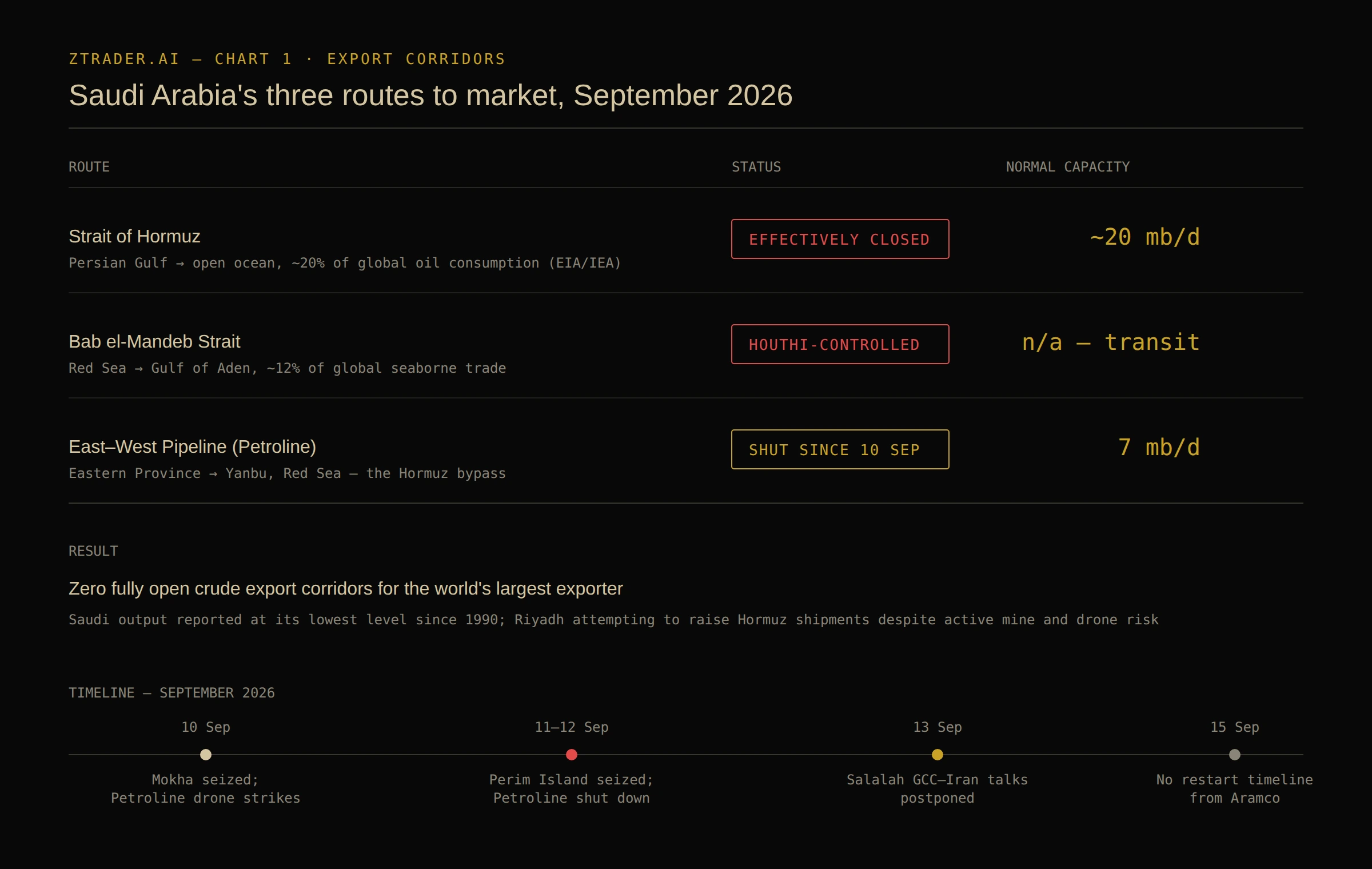
Saudi crude output has reportedly fallen to its lowest level since 1990. Riyadh is, per reporting this week, quietly trying to push more barrels back through Hormuz anyway — which tells you everything about how bad the alternative math looks internally. That is a kingdom choosing the chokepoint with active mine warfare over the one with no throughput at all.
This is also worth noting: an almost comically asymmetric trade for Iran and its proxies. A handful of drones and an amphibious infantry push cost a rounding error compared to what they've done to global energy logistics. Petroline alone moves 7 million barrels a day — about 7% of global consumption — and it went offline because of a few dozen munitions and some fast boats.
THE NUMBERS
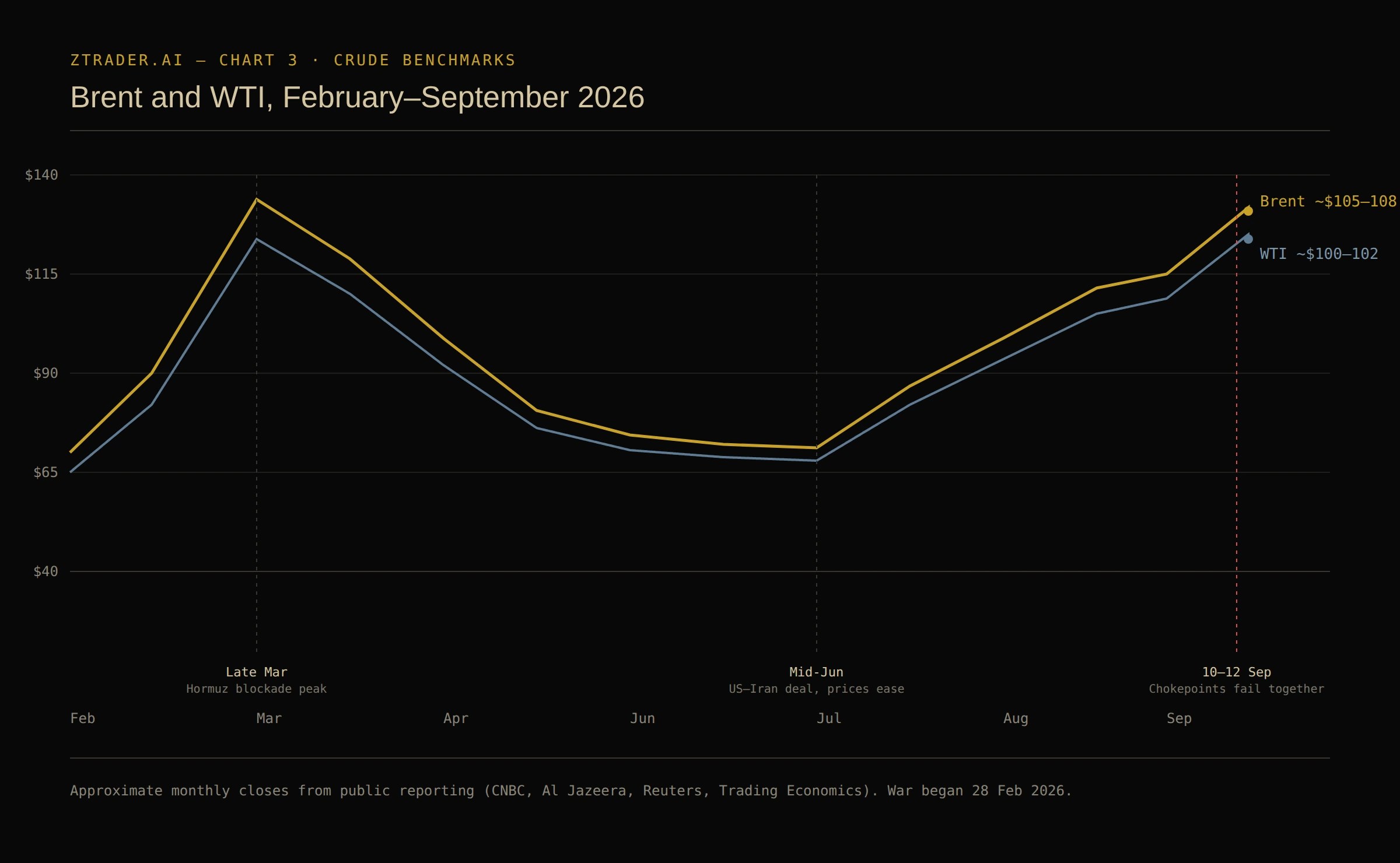
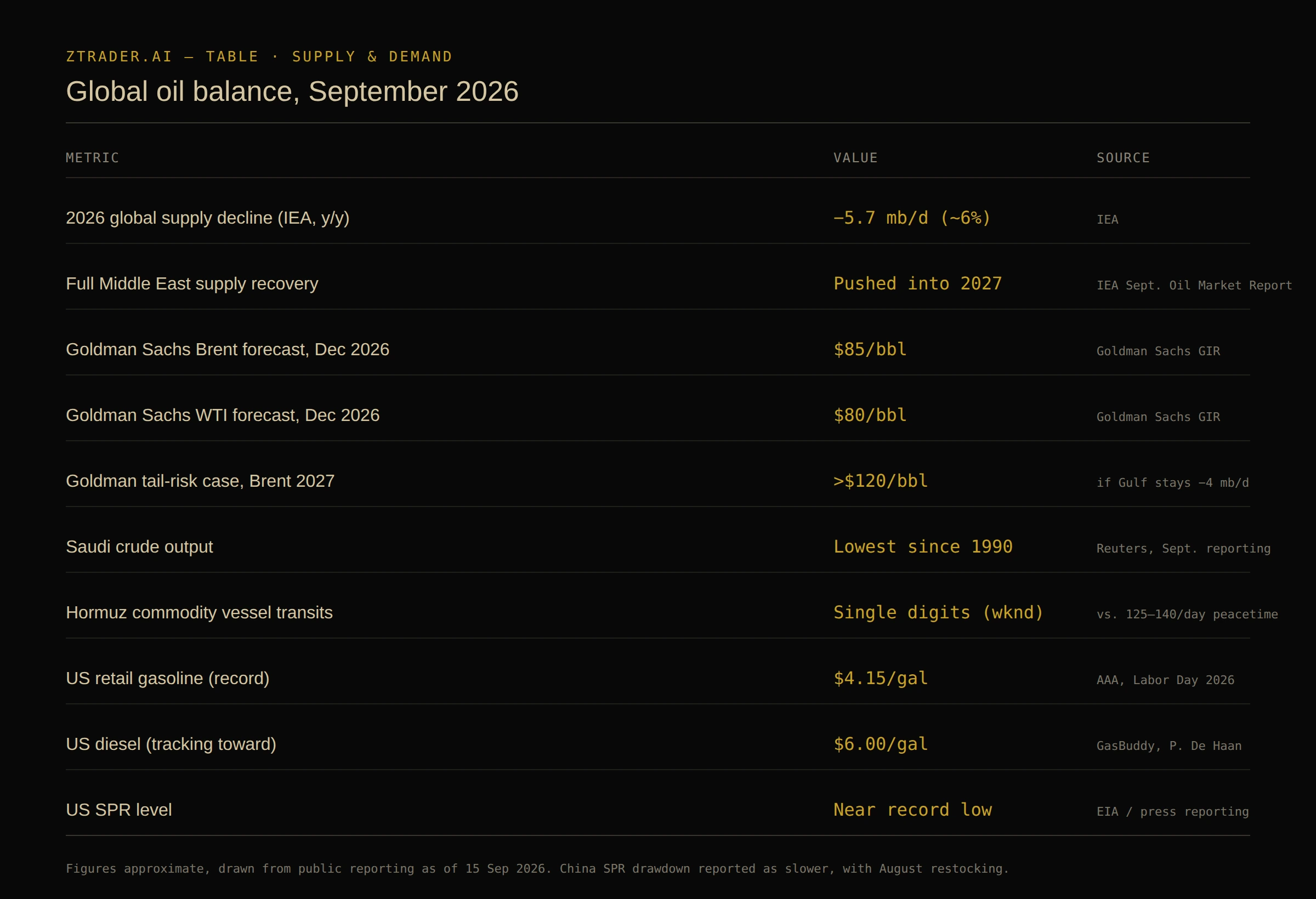
The whiplash in Goldman's own forecasts across this year is the chart that tells the whole story better than any single price print.
Up to $90+ in the spring war peak.
Cut to $75-80 in June on the reopening deal.
Back up to $85/$80 now, with an explicit written warning that $120+ is the disorderly-escalation case.
That's not a model being wrong. That's a model correctly pricing a war that keeps almost ending and then doesn't.
THE PATIENT CHESS PLAYER
Not everyone perceives the war this way.
YOU ARE BEING WAY TOO PESSIMISTIC, THEY MAY ARGUE.
Therefore, this is where the REAL ALPHA HIDES — especially while everyone else still underestimates the current status quo.
China has spent the entire war quietly insulating itself — leaning on its strategic oil reserves, buying opportunistically when Iranian and sanctioned-barrel discounts widen, and using August's dip to restock rather than draw down further. Beijing's position, repeated by its own officials, is that it has "managed this situation successfully since the beginning." Convenient, when your main crude artery from the Gulf isn't the only route you depend on and your government doesn't answer to gas-pump politics.
The US is the mirror image: its oil SPR is near record lows after multiple drawdowns to blunt the price spikes, meaning the next leg of this crisis has less of a shock absorber underneath it than the last one did. Asian refiners dependent on Middle Eastern grades — per Rystad Energy commentary this week — are the ones most exposed to a prolonged Yanbu outage, since you can't just reroute Eastern Province crude to a shut pipeline.
Europe's diesel market is its own separate mess, tangled up with Russian refinery strikes on top of the Gulf story, which is why Goldman is still recommending long positions in deferred European diesel timespreads as a hedge, not just outright crude.
THE CHESSBOARD
MBS reportedly called Trump twice in one day pushing for US strikes on the Houthis as they closed in on Mokha. Trump said no — Washington isn't interested in widening the campaign beyond Iran itself.
BUT WHO STARTED THIS WAR IN THE FIRST PLACE?
AND WHO WAS TOLD THAT IRAN COULD BE EASILY HANDLED?
The US wants this contained to a state-vs-state framing it can eventually negotiate away; Iran's strategy is explicitly to keep opening fronts through proxies that don't require Tehran to sign anything. Every new Houthi advance is a new pressure point Washington didn't choose and can't easily close by talking to Tehran alone.
That mismatch — one side needs a single negotiated off-ramp, the other side just needs more chokepoints — is why "de-escalation" headlines keep dying within weeks of appearing. It happened in June.
The current dilemma is massive: we cannot manufacture new chokepoints, nor can we scale up alternative pipelines fast enough. Iran is locked into a strategy of relentless attrition, bleeding the global economy through sustained inflation. By weakening Western economic leverage, they are positioning themselves to dictate future energy prices at will. For now, they are just juicing the market for sport.
This is merely the opening act.