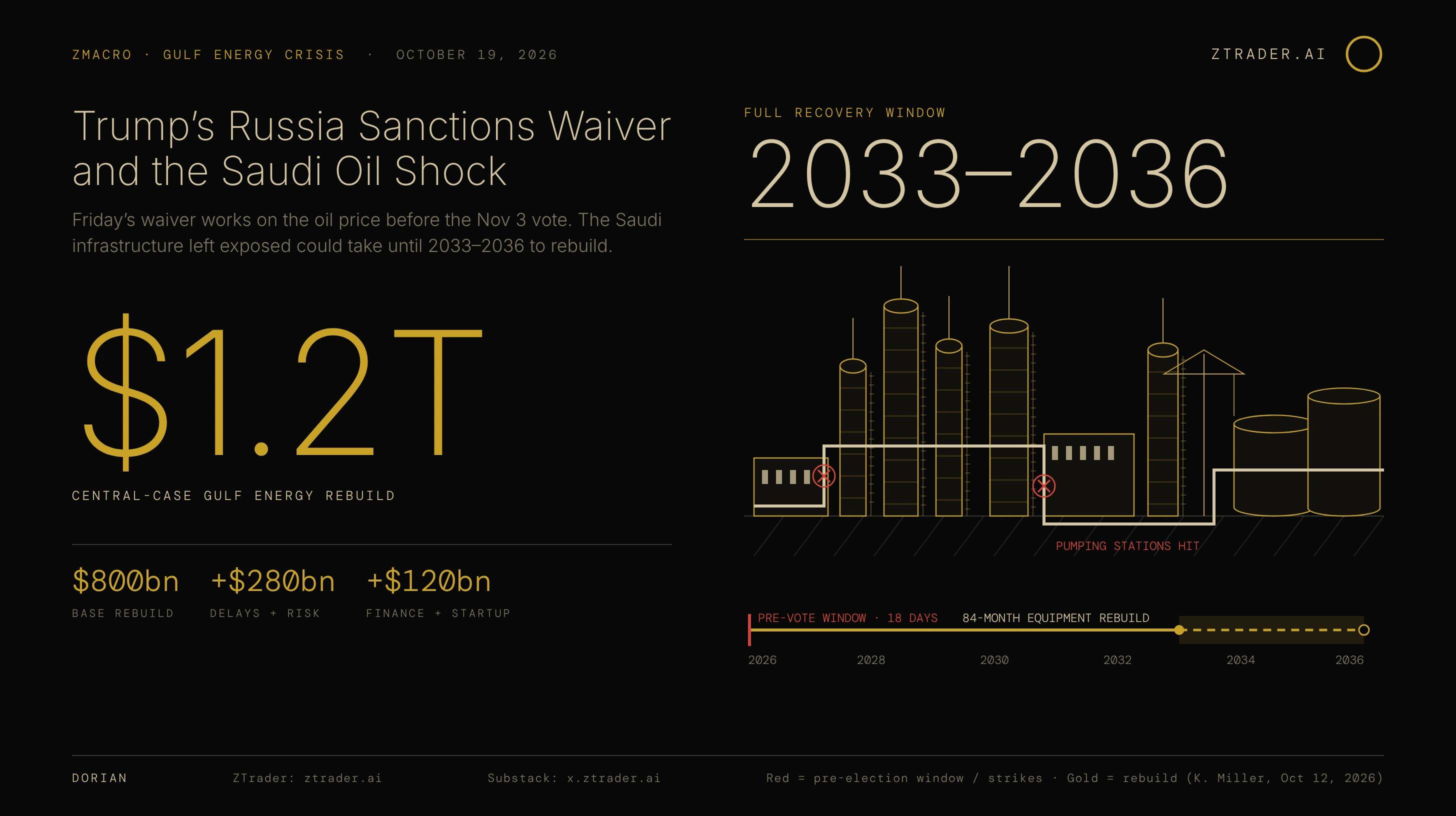
Trump’s Russia Sanctions Waiver and the Saudi Oil Shock
You don’t show weakness to a rival,
and you certainly don’t win a war by being weak.
That is precisely what Trump is doing right now.
By signing an executive order late Friday night, Donald Trump neutralized major new Russia sanctions just days before their enforcement deadline. Market reaction was swift: Brent opened Monday’s Asian session down 1.4% at $108.35, while Treasury yields continued their retreat from recent peaks.
For an administration facing voters in less than three weeks, this brief price reprieve is the ultimate scorecard.
Yet traders shouldn’t mistake a political quick-fix for a structural solution. The waiver alters market sentiment, but leaves the physical production base completely untouched—a system currently under severe threat in Saudi Arabia, the sole remaining lifeline for global oil after the closure of Hormuz.
The key to this trade isn’t what the order says, but when it was issued. Master the timing, and you’ll know precisely when this relief rally crumbles before the crowd catches on.
IWhat Trump Signed on Friday Night
The Executive Order targets the bipartisan Lindsey O. Graham Sanctioning Russia and Iran Act, which Trump signed into law last month.
Designed to choke off Moscow’s war revenue, the statute authorized tariffs of up to 500% on Russian goods and up to 100% on major foreign buyers of Russian energy.
However, just days before enforcement, Trump waived the penalties, citing ‘national interest.’ Addressing the swift move, Secretary of State Marco Rubio clarified that the waiver is merely a ‘60-day pause’ to analyze the sanctions’ impact on global energy prices and economic stability—particularly amidst Middle East turmoil and diesel market volatility.
Connecting the Dots: Trump’s 8-Day Energy Gambit
Over an eight-day span, the administration executed three tactical maneuvers, all aimed at a single target:
- Oct 9 (Diesel Supply)Trump struck a deal with Moscow to import millions of tonnes of Russian diesel, backed by an immediate Treasury waiver.
- Oct 11 (Refinery Ceasefire)Trump pressed Ukraine into a pause on drone strikes against Russian oil facilities.
- Oct 16 (Sanctions Freeze)Trump suspended the Graham-backed Russia tariffs just days before they were set to take effect.
Every move serves the same election-year playbook: Suppress fuel prices, tame bond yields, and soothe voters before Nov 3.
The Market VerdictIt offered a fleeting victory.
Brent crude gave back part of the previous week’s nearly 5% rally immediately following Friday’s announcement—proving that while policy interventions can spook prices short-term, they rarely alter long-term market fundamentals.
IISaudi Arabia, the Last Bypass
Following the closure of the Strait of Hormuz in March, Saudi Arabia executed a maneuver no other regional producer possessed the infrastructure to replicate: redirecting crude flows from East to West.
Utilizing the 1,200-kilometer East-West Pipeline (the Petroline)—which spans the Arabian Peninsula to the Red Sea port of Yanbu—Riyadh scaled operations dramatically.
With a nameplate capacity of 7 million barrels per day, throughput hit 5.8 million bpd on October 6.
This pipeline alone stands between a $108 Brent price and absolute market chaos. For most of this crisis, Saudi Arabia has functioned as the global energy market’s sole stabilizing force.
Under Fire: The Destruction of Saudi’s Lifeline
Now, the world’s ultimate shock absorber is itself under direct attack.
Since September, a coordinated escalation has systematically crippled Saudi Arabia’s energy infrastructure:
- Sept 11 (The Pipeline Shutdown)Drone strikes attributed to Iraqi militias forced Aramco to halt the East-West Pipeline entirely. Yanbu loading operations froze for 17 days, leaving multiple European refiners with zero Saudi crude allocations for October.
- Oct 4 (Pumping Station Sabotage)A critical pumping station at Khurais was struck for the first time. The pipeline ground to a halt once again.
- Oct 6–13 (Houthi Blitzkrieg)Houthi forces launched a devastating barrage. Between Oct 6 and 12, missile and drone attacks targeted three Saudi airports, leaving over 20 dead and 370 wounded.
On Oct 13, the strikes hit home—directly impacting Aramco’s headquarters in Dhahran, heavily damaging executive floors, reportedly including the CEO’s office.
Declaring all Saudi energy infrastructure and airports “legitimate targets,” Houthi forces have explicitly warned civilians to evacuate.
The financial fallout is already stark. As analyst Larry Johnson notes, Saudi oil activity plunged by 25% in Q2 alone, dragging overall GDP down by 4.8%. The market is no longer pricing in a potential disruption—it is watching a live destruction of supply.
IIIWhere the Damage Actually Sits
Why a Pipeline Is Not Just a Pipe
Mainstream coverage treats each strike like a temporary plumbing issue: shut, repair, restart. That misunderstands engineering reality.
The East-West line is an interdependent chain. Pumping stations, power grids, telemetry controls, storage tanks, and loading berths must function in absolute lockstep. Break a single link, and the entire 1,200-kilometer system collapses. Yanbu doesn’t need to be bombed to go dark—if the upstream crude dries up, the tankers stop loading.
Measuring risk against the 5.8 million bpd benchmark, the math quickly gets terrifying:
- 1 Week of Interruption40.6 million barrels lost.
- 1 Month of Interruption174 million barrels wiped out.
These are stress-test figures, and the line is not totally offline today. But they expose just how exponentially supply losses compound when a critical arterial fails.
The 84-Month Reality: Why Recovery Extends to 2036
Modern energy infrastructure cannot be restocked like off-the-shelf parts. Heavy industrial hardware—high-capacity compressors, specialized turbines, high-voltage transformers, and heavy-walled pressure vessels—is strictly custom-engineered.
The lead times for replacing a destroyed energy package are brutal:
- Year 1Damage assessment, engineering design, and capital allocation.
- Years 2–4Procurement, metallurgical casting, and custom manufacturing.
- Years 5–6Global transport, civil engineering, and site installation.
- Year 7System commissioning, stress-testing, and stabilization.
That is a baseline 84-month timeline (7 years). Add factory queues, geopolitical friction, or follow-up strikes, and the lead time easily stretches to 10 years.
Partial flows can be patched together earlier. But full, resilient, and reliable capacity will not return to the worst-hit Gulf systems until 2033 to 2036.
Capital Requirements & Structural Capacity Constraints
The required capital expenditure aligns directly with this multi-year timeline. Rebuilding the wider Gulf energy infrastructure carries a price tag ranging from $550 billion (controlled case) to $2.28 trillion (severe case), with a base-case valuation of $1.2 trillion.
Crucially, this is not merely a funding challenge, but a physical capacity bottleneck: every Gulf state will be simultaneously bidding for limited production slots at the handful of global facilities capable of manufacturing high-voltage transformers.
| $ billions | Controlled | Central | Severe |
|---|---|---|---|
| Base reconstruction capital | 400 | 800 | 1,400 |
| Execution uplift (security, delays, escalation) | 100 | 280 | 630 |
| Finance and startup liquidity | 50 | 120 | 250 |
| Total funding envelope | 550 | 1,200 | 2,280 |
When Washington speaks of market relief, conflating financial temporary fixes with physical infrastructure is a fatal mistake.
Paper prices can adjust in days; heavy industrial pumping stations require a decade.
IVThe Midterm Calculation: October 13–16
A Delayed Retaliation
On Tuesday, October 13—hours before Houthi missiles struck Aramco’s corporate headquarters in Dhahran—Trump claimed that the strikes were calculated to drive up oil prices before the elections. His response: “I’ll be there after the Elections, and I will never forget!”
The subtext was undeniable: Washington’s security umbrella for the Gulf is paused until after November 3.
The Policy Pivot
Seventy-two hours later, Trump issued an executive order waiving punitive tariffs and sanctions on Russian energy to force supply into the market.
The Strategic Reality
Taken together, these actions reveal an unmistakable hierarchy of priorities. Leading up to the midterms, domestic gas prices supersede foreign policy deterrence. Rather than penalizing those disrupting global energy, the administration has actively accommodated them—pressing Kyiv to pause refinery strikes, opening doors for Russian diesel, and withholding military responses in the Gulf.
VThe Strategic Calculation in Tehran and Sana’a
If you are sitting in the command rooms of Tehran or Sana’a, the past eight days delivered a masterclass in American vulnerability:
- A Guaranteed Window of ImmunityWashington will not launch a major military response before November 3. President Trump effectively signed this hall pass himself.
- The Domestic Achilles’ HeelOil prices are America’s ultimate political pressure point. Trump’s Russia waiver proves he will willingly burn geopolitical leverage just to buy short-term price relief.
- The High-Yield TargetSaudi energy infrastructure is the ultimate lever. Every successful strike spikes Brent, and every cent at the pump bleeds political capital from the White House right before voters hit the polls.
Unsurprisingly, the Houthis have already vowed to escalate strikes against Saudi airports and Aramco facilities in the coming days. Nothing in Friday’s waiver deters them—if anything, it validates their strategy.
And the choice of target is where this gets catastrophic: Strike a supertanker, and you destroy a single cargo. Strike a main pumping station, a high-voltage substation, or a SCADA control node, and you start Miller’s 84-month lead-time clock.
Every missile that lands during this pre-election window inflicts physical damage that will linger for a decade after the election ballots are cast and forgotten.
VISupply Substitution Constraints: Houston and Moscow
Global energy markets face a structural deficit in middle distillates—specifically diesel, jet fuel, and heating oil, which form the logistical backbone of commerce and industry. Miller’s baseline estimates place the global structural shortfall in diesel and jet fuel at 3.0 million bpd.
As Saudi export reliability degrades, market assumptions rely heavily on incremental supply from the United States and Russia. However, physical capacity constraints render this assumption unviable.
U.S. Refiner Capacity Limits
For the four-week period ending October 2, U.S. distillate production averaged 5.17 million bpd, with 3.77 million bpd absorbed domestically and 1.56 million bpd exported.
Offsetting the 3.0 million bpd global deficit would require a 58% surge in total U.S. distillate refining output. For context, net U.S. production has expanded by merely 150,000 bpd year-over-year—meaning the current supply gap exceeds annual production gains by a factor of twenty.
Reallocating domestic supply toward foreign exports does not solve the deficit; it merely exports domestic inflation. This structural tightness is already reflected at the pump, with U.S. diesel prices sustaining levels above $6.00 per gallon.
The Russian Supply Deal: Volumetric Limits
Political announcements regarding Russian diesel imports obscure severe quantitative limits. Converted from metric weight, the full 4.8 million tonne agreement yields approximately 35.8 million barrels—assuming zero logistical or refining disruption in Russia.
Against U.S. daily diesel consumption of 3.7 million barrels, the entire supply package represents under ten days of domestic U.S. consumption.
Consequently, Goldman Sachs estimates that the near-term October and November volumes will reduce wholesale diesel prices by merely $1.00 to $2.00 per barrel. The deal provides marginal headline relief without altering the structural supply-demand balance.
| Tranche | Tonnes | Barrels | Condition |
|---|---|---|---|
| Immediate (October) | 300,000 | 2.24M | Announced |
| November | 500,000 | 3.73M | Announced |
| Immediately after | 1,000,000 | 7.45M | Announced |
| Later | 3,000,000 | 22.35M | Depends on refineries |
| Total if fully delivered | 4,800,000 | 35.76M | — |
The Operational Reality: Can Russia Even Deliver?
The fundamental flaw in the Trump-Putin deal isn’t just political—it’s physical. Can Russia actually export these barrels?
Moscow didn’t ban diesel exports on July 8 out of geopolitical spite; it did so out of domestic desperation as Ukrainian drone strikes systematically crippled its refining capacity. By September, Reuters confirmed that three of Russia’s six primary diesel refineries had shut down or severely curtailed throughput.
Kyiv’s agreement to pause refinery strikes lasted a mere three days. On October 15, Ukrainian drones struck the Ryazan refinery—a major industrial hub accounting for nearly 5% of total Russian refining capacity—setting the plant ablaze and taking a primary distillation unit offline.
Sources: Meduza; Reuters
The Math of Absolute Insufficiency
Now, contextualize Russia’s promised volume against the Saudi Arabian risk profile:
- The Saudi EscalationMiller calculates that ongoing disruptions to Saudi infrastructure could expand the global distillate deficit from 3.0 million to 3.5 million bpd—adding 15 million barrels of net supply shortfall every month.
- The Russian IllusionThe entire 35.8-million-barrel Russian deal barely covers ten weeks of that incremental increase alone.
- The Macro RealityMeasured against the baseline 3.0 million bpd global gap, the entire Russian supply package sustains the world economy for a trivial 12 days.
In short, Washington is trading off long-term geopolitical leverage for less than two weeks of illusory energy relief.
From Backstop to Black Hole: The Gulf’s Structural Collapse
The IEA’s numbers show the same squeeze from another angle. Global seaborne diesel and gasoil exports averaged 4.7 million barrels a day in the first eight months of 2026, down 10% on the year.
VIIPost-Election Capital Costs
1. Rates Reprieve vs. Structural Drivers
The immediate beneficiary of Washington’s tactical intervention was the sovereign bond market.
Prior to the policy blitz, the benchmark 10-year U.S. Treasury yield touched 5.31% on October 5—its highest level since 2002.
Driven by temporary supply expectations from the diesel deal and the energy ceasefire, yields retreated to 5.10% by October 15 and settled near 5.07% in Monday’s Asian session, after Friday’s waiver.
While this 24-basis-point retreat achieves the administration’s immediate objective of dampening capital costs ahead of the midterms, it alters none of the fiscal or inflationary fundamentals. The rate relief is borrowed time, backed by borrowed oil.
2. The Anatomy of a Fleeting Bond Rally
Don’t mistake panic for fundamental relief. The largest single-day drop in yields occurred on October 15—driven not by structural disinflation, but by a global tech rout and equity selloff that forced capital into Treasuries for safety. That is a flight-to-safety rally born of fear, and fear always reverses.
The yield relief tied to energy depends on cheap fuel sticking around. If Saudi strikes persist and middle distillates remain constrained, structural inflation stays locked in. When reality reasserts itself, the long end of the yield curve will surrender these gains—and then some.
3. The Real Economy: The Mathematical Price of Delay
Supply destruction carries an escalating interest rate. Every year that 1 million bpd of fuel capacity remains offline forces the market to source 365 million replacement barrels elsewhere—costing roughly $55 billion annually at Miller’s baseline $150/barrel scenario. Delaying the core reconstruction by just three years adds $76 billion to $125 billion in cost inflation, plus another $42 billion to $90 billion in compounding financing costs.
This isn’t a theoretical risk; it is already burning through the real economy. Cereal prices are up 17.2% year-over-year. Farmers must buy diesel long before harvests generate cash; truckers need fuel before invoices clear. Dollar-starved developing nations won’t just pay higher prices—they will be systematically priced out of survival.
4. The Military Escalation Trap
Then comes the deferred bill: the military response Trump promised for post-Election Day.
Should Washington join Saudi operations against the Houthis in November, the theater immediately expands into the Red Sea and the Bab el-Mandeb strait—the exact southern choke point through which Yanbu’s Asia-bound crude must flow. The Houthis have already declared American military assets targetable.
The Trajectory
The full macro cascade now runs in lethal sequence:
- The Tactical Waiver buys a brief political window of suppressed paper prices.
- Physical Sabotage continues unabated throughout this window, pushing destruction deeper into Miller’s 84-month lead-time clock.
- The Delayed Military Response hits the precise maritime arterial the Saudi bypass relies upon.
Trump’s executive order didn’t fix the energy system; it merely pawned the global energy architecture to buy three weeks of domestic political quiet.
When the bill comes due after November 3, the market won’t just pay for the oil—it will pay for the time wasted.